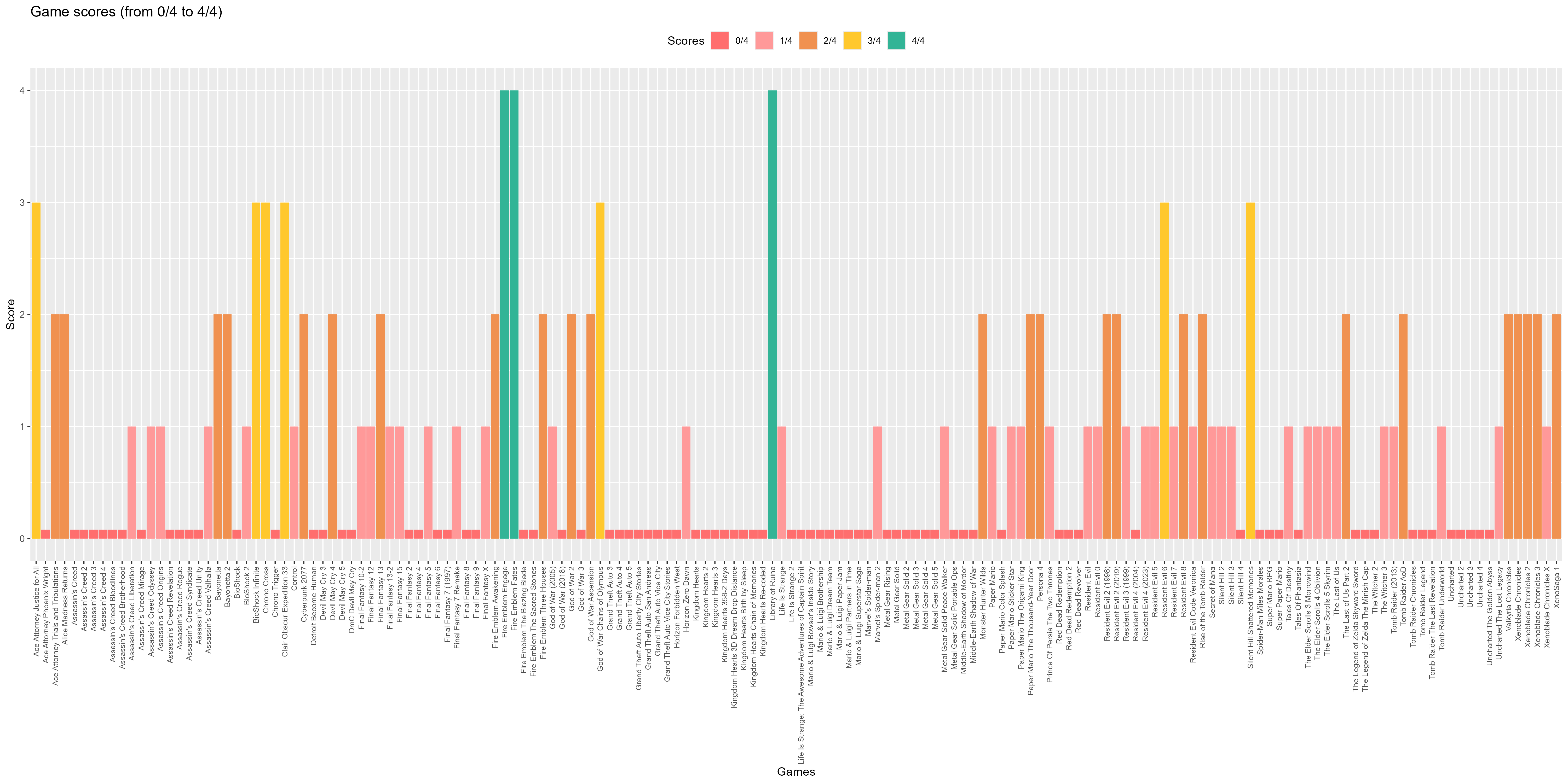
The Gender Parity Test is a measurement tool developed by the École des Hautes Études Commerciales du Nord (EDHEC) Diversity & Inclusion Chair, in order to assess the parity (defined as “equality in the number of representatives”) of female and male characters in the dialogues of story-driven video games (primarily role-playing games (RPGs), action-adventure games, and adventure games). Inspired by the Bechdel test for film, the Gender Parity Test is based on the four questions shown, available in the table below. To pass the test, a video game must receive a positive answer to all four questions. To date, out of 0 games analysed, only 0 pass this test.

Number of games analysed to date: 0 Help us to add games, click here.

The 4 questions Number of positive answers
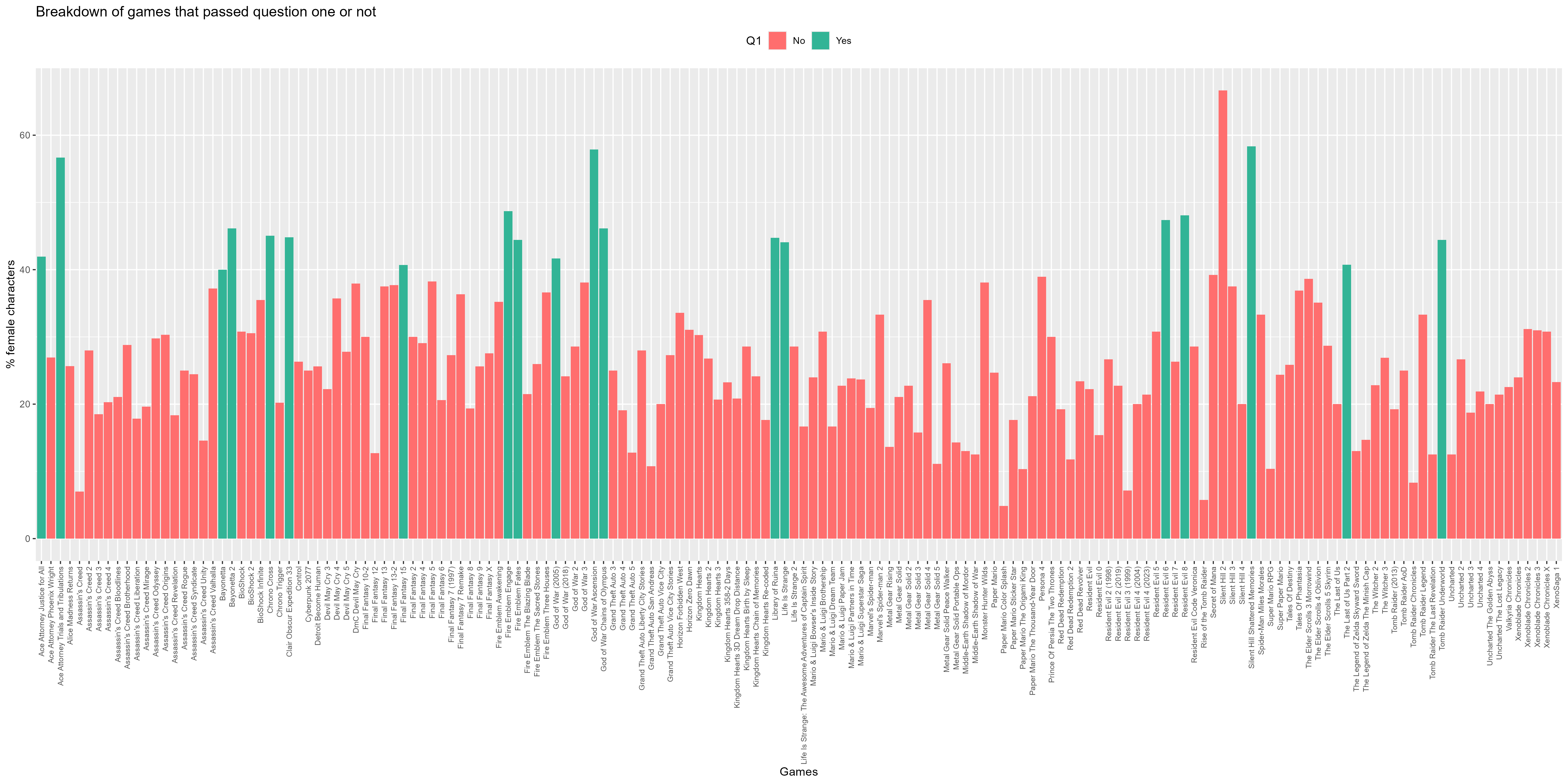
Q1 - Does the script include an equal number of female and male characters?

The graph is now displayed below the table.

0 games out of 0
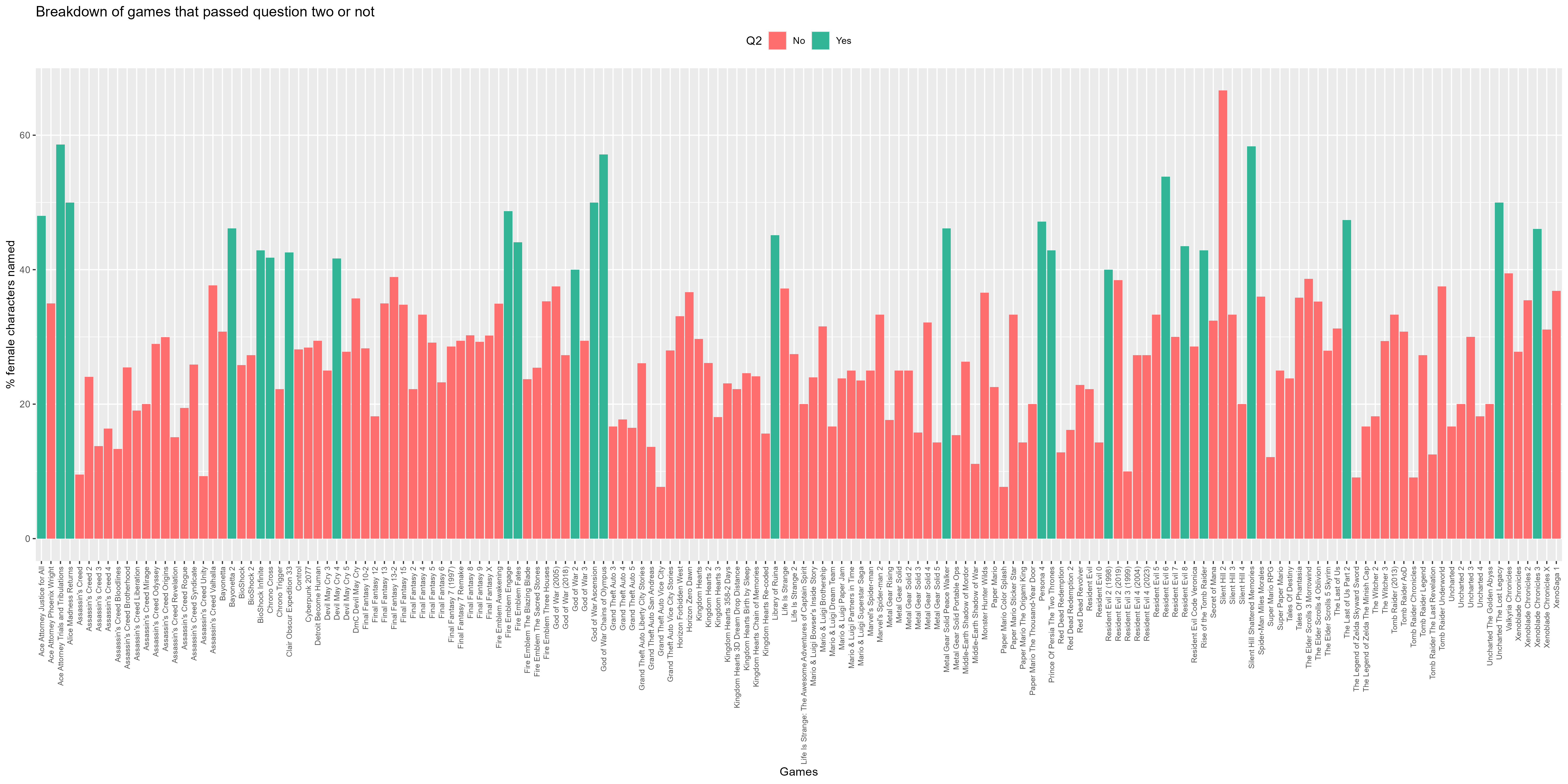
Q2 - Does the script include an equal number of named female and male characters?

The graph is now displayed below the table.

0 games out of 0
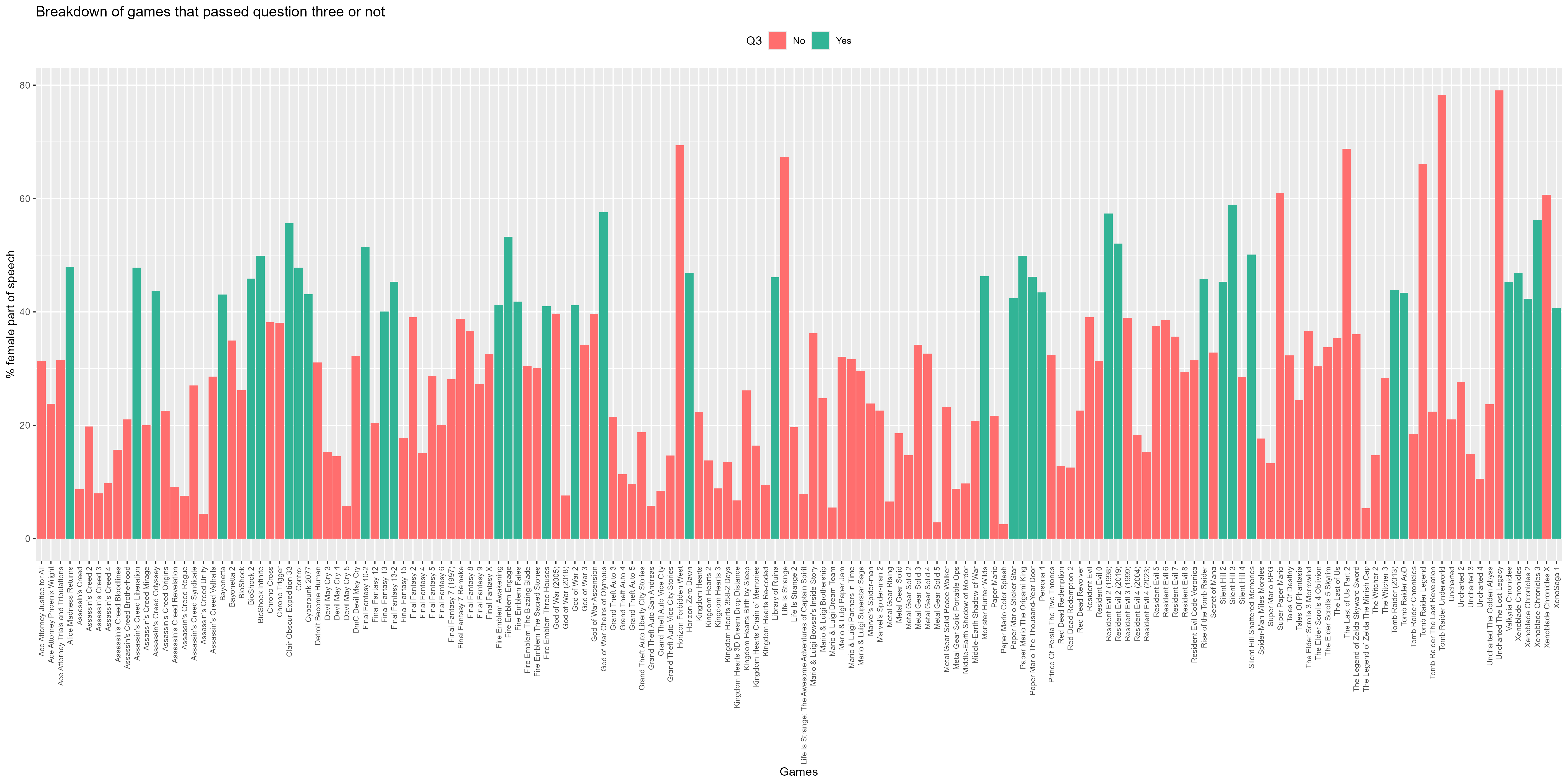
Q3 - Do the female and male characters in the script speak an equal number of words?

The graph is now displayed below the table.

0 games out of 0
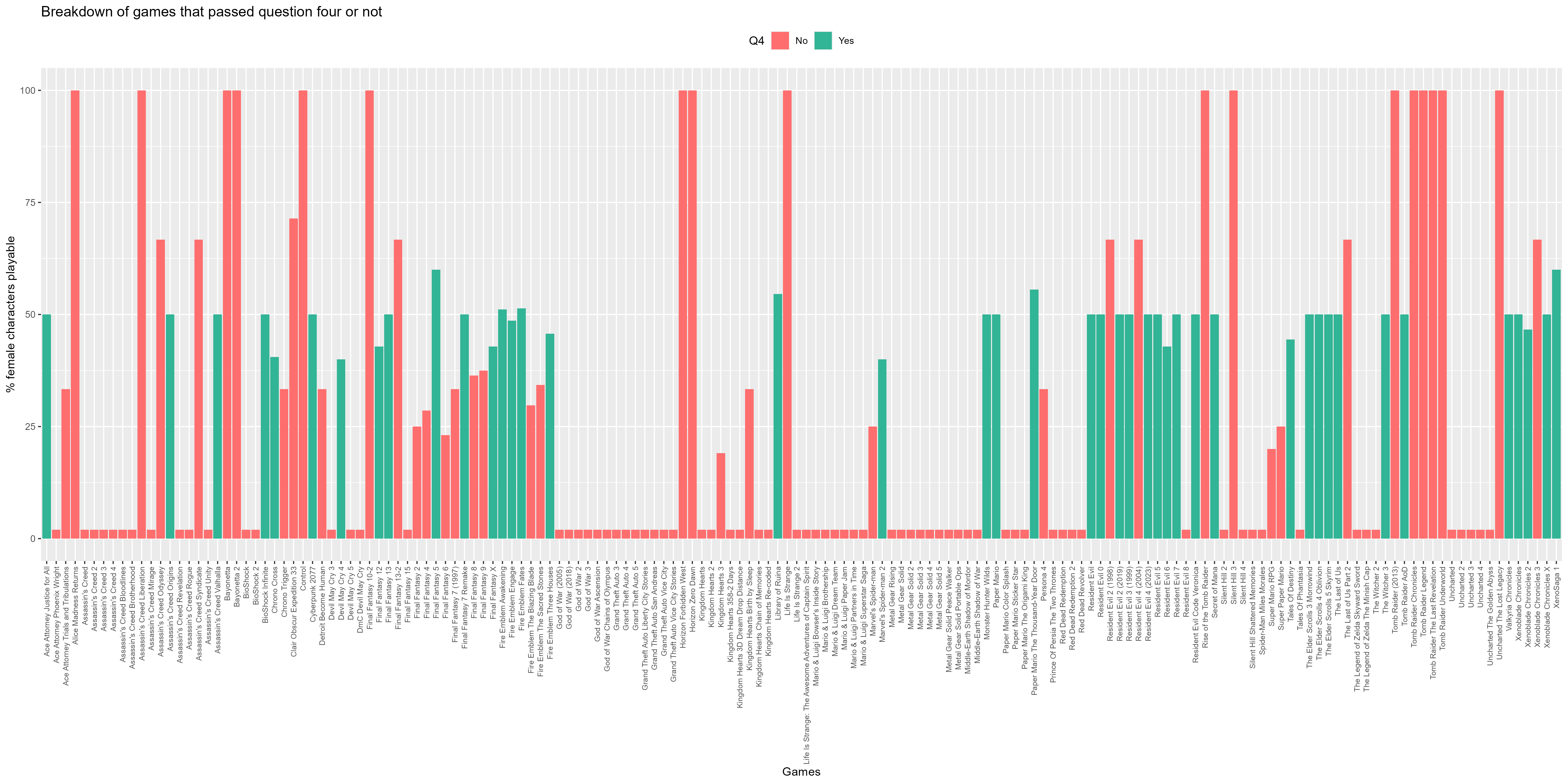
Q4 - Does the game include an equal number of playable female and male characters?

The graph is now displayed below the table.

0 games out of 0
Number of games receiving 4 positive answers

The graph is now displayed below the table.

The table is now displayed below the table.

Number of games passing the test (4/4) 0
Number of games receiving 3 positive answers (3/4) 0
Number of games receiving 2 positive answers (2/4) 0
Number of games receiving 1 positive answer (1/4) 0
Number of games receiving 0 positive answers (0/4) 0
0 games out of 0

Reading note regarding question 2 (Q2): of the 0 games analysed, 0 received positive answers on question 2, thereby indicating that they have an equal number of named female and male characters.

Number of games passing the test (4/4) 0
Number of games receiving 3 positive answers (3/4) 0
Number of games receiving 2 positive answers (2/4) 0
Number of games receiving 1 positive answer (1/4) 0
Number of games receiving 0 positive answers (0/4) 0
Graphique des jeux validant la question 1 Graphique des jeux validant la question 2 Graphique des jeux validant la question 3 Graphique des jeux validant la question 4 Graphique des scores des différents jeux
Number of games passing the test 0
Number of games receiving 3 positive answers 0
Number of games receiving 2 positive answers 0
Number of games receiving 1 positive answers 0
Number of games receiving 0 positive answers 0

Why the test?

Since 2006, video games have been considered the “10th art” by the French Ministry of Culture. They exert an undeniable influence on society and mentalities and surpass cinema, television and music in terms of audience.

According to France’s national centre for film and images (CNC), (2025), the majority of French people (73%) play video games, at least occasionally. 44% of French people play every day or almost every day, and 19% play “a few times” per week. Both the majority of women (69%) and men (77%) play video games, but some gaming habits differ according to gender: there are more men among highly engaged gamers, and more women among those playing solely smartphones.

Given the reach of this medium and the inequalities that still exist, it appears essential to analyse video games through the lens of gender. By doing so, the EDHEC Diversity & Inclusion Chair aims to contribute to improving the representation and portrayal of women in game scripts.
A word cloud to introduce the Gender Parity Test

Methodology

The results were obtained through a methodological protocol that used five criteria to select the video games to be tested:

  1. the video game is a story-driven game that primarily falls within the action-adventure, adventure, or role-playing game (RPG) genres (or one of their sub-genres)
  2. the game’s story mode can be played offline
  3. an official English-language version is available, and transcripts of its dialogue are accessible on websites (wikis/blogs)
  4. the game includes at least 150 lines of dialogue
  5. the game has sold at least one million copies, according to available estimates

The transcripts were collected via websites and analysed using R and Python code created by the Diversity & Inclusion Chair. Characters were classified as male or female (or “other” and “unknown”; the dialogues of “other” or “unknown” characters were not taken into account) by consulting the game's wikis.

If the player has the possibility of choosing their character’s gender in the game, then the lines are duplicated to represent both possibilities. Equal representation of male and female characters is considered to exist when the parity threshold is reached; this threshold is set between 40 and 60%.

The test does not address the way in which female and male characters are visually represented. Although this aspect is essential for measuring potential gender stereotypes, it was decided for methodological reasons to focus the test on the narrative part (dialogues) of video games.

They’re talking about the test!