
China: The New Geography of Electricity
How Beijing is betting on coal and renewables to power its industry and geopolitical ambitions
Behind China's Power, an Electricity System in Transformation
Industry is today the main driver of Chinese growth, while industrial exports have become a major instrument of Beijing's power on the international stage. Ensuring the continuity and expansion of manufacturing output is therefore a strategic imperative for China's leaders. This map deciphers the electricity strategy Beijing has deployed to meet this imperative and thereby support its economic and geopolitical ambitions.
Responding to Domestic and External Constraints
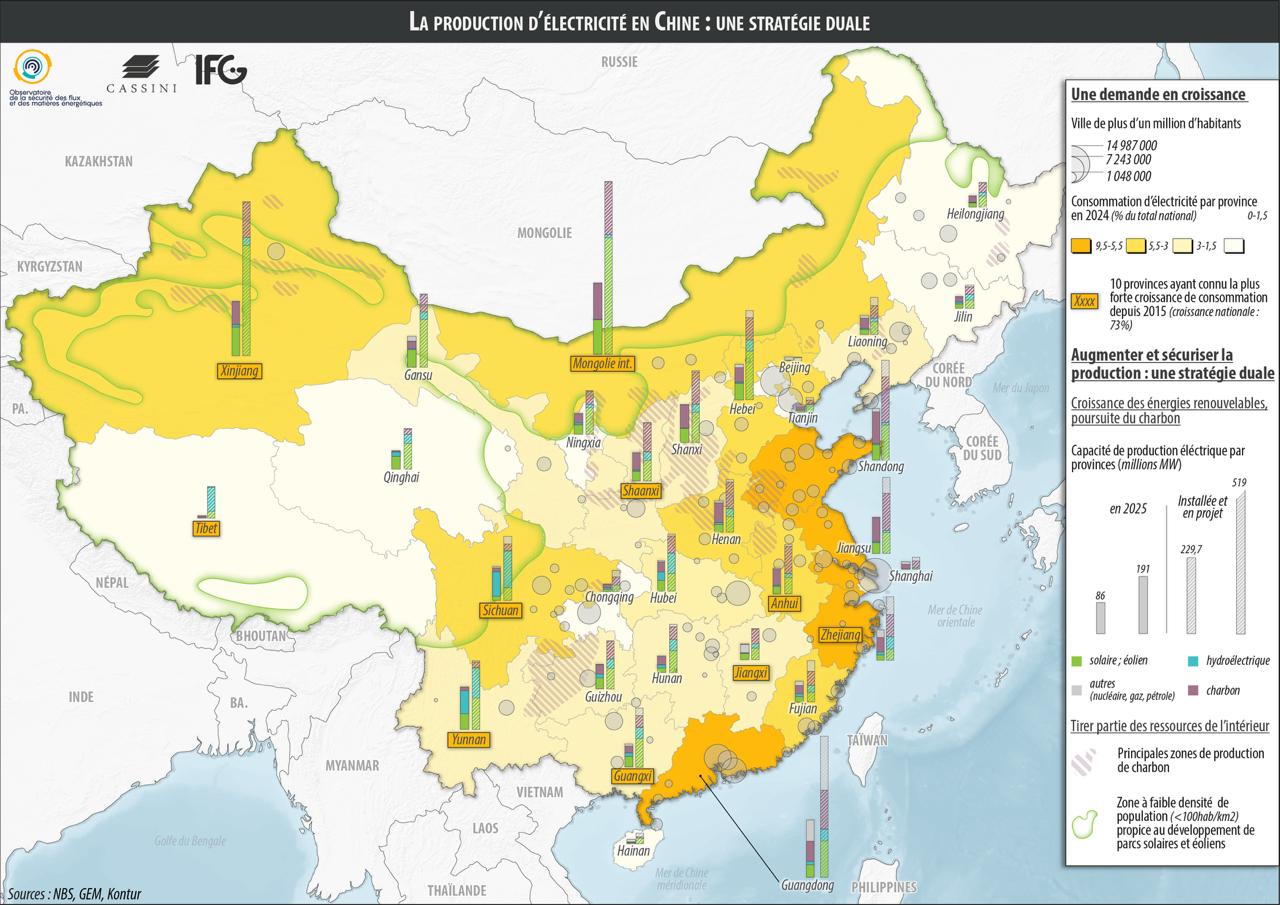
This strategy responds to both domestic and external challenges. At home, it has accompanied the rapid evolution of China's energy mix, which has enabled industrial upgrading and supported the emergence of a middle class. Between 2015 and 2025, electricity consumption rose by nearly 87%. Per capita, it now exceeds that of France. The electrification of uses is also a means of limiting global warming, an issue very present in Chinese public debate, and thus of bringing about what the ruling class calls an "ecological civilization". Internationally, the development of domestic electricity generation capacity, particularly renewable, is linked to the political elites' desire to shed external dependencies.
A Dual Electricity Generation Strategy
In this context, Beijing has pursued a dual policy based on the use of coal and the intensive development of renewable energy. Whereas in the early 2000s coal was mainly consumed directly by industry, its use has gradually shifted toward electricity generation. Electricity produced from this fossil fuel has the advantage of being easily dispatchable, a major asset for industrial consumption, not to mention that it sustains a domestic extractive activity essential to China's coal basins. In the long run, coal use is set to decline, since China has set itself the goal of carbon neutrality by 2060.
To this end, Beijing has massively developed renewable energy production. This strategy was accelerated by the partial closure of European and US markets to imports of Chinese solar panels, following anti-dumping measures taken in 2013. Driven by massive investment (625 billion in 2024) in solar, wind and hydropower, renewable energy accounted for 31% of China's electricity generation in 2024.
The Stakes of China's New Electricity Geography
This strategy is profoundly transforming the geography of electricity generation in China, in favor of growing regional specialization. The massive deployment of wind and solar farms mainly concerns the sparsely populated and meteorologically favorable provinces of the north and west, such as Inner Mongolia and Xinjiang. Major hydropower projects are concentrated in the mountainous regions of the southwest. A dichotomy is thus emerging between the most productive, surplus regions of the west and the populous, deficit regions of the east.
This geography is essential to understanding the new vulnerabilities of China's electricity system. Renewable energy generation now exceeds the transmission and distribution capacity of the power grid. To meet these challenges, China must invest in developing and deploying technologies it has not yet fully mastered. These include ultra-high-voltage lines, which make it possible to transport electricity over long distances while limiting losses, as well as storage systems and "smart grids", which are essential for distributing electricity to the right place, at the right time, according to needs.