
Cuba: The Geopolitics of Asphyxiation
An openly declared strategy of asphyxiation, paid for by the Cuban people
Cuba: The Geopolitics of Asphyxiation
An openly declared strategy of asphyxiation, paid for by the Cuban people
On 18 September, a nationwide power outage once again plunged Cuba into darkness. According to the Ministry of Energy and Mines, it was the eighth total collapse of the grid since the start of 2026, leaving some nine million Cubans without electricity. Four days later, at the United Nations podium, Donald Trump called the island a failed state and announced that freedom would soon arrive there. Nine months after the capture of Nicolás Maduro and the halt of oil deliveries to Cuba on 3 January, the US strategy of suffocation has accelerated the destruction of the island's economy, already in very poor shape since the COVID-19 crisis and the renewal of sanctions under Trump I. Indeed, Venezuela supplied up to 100,000 barrels of oil per day at the height of the alliance, and the regime resold about half of it on the world market, which was a significant source of foreign currency.
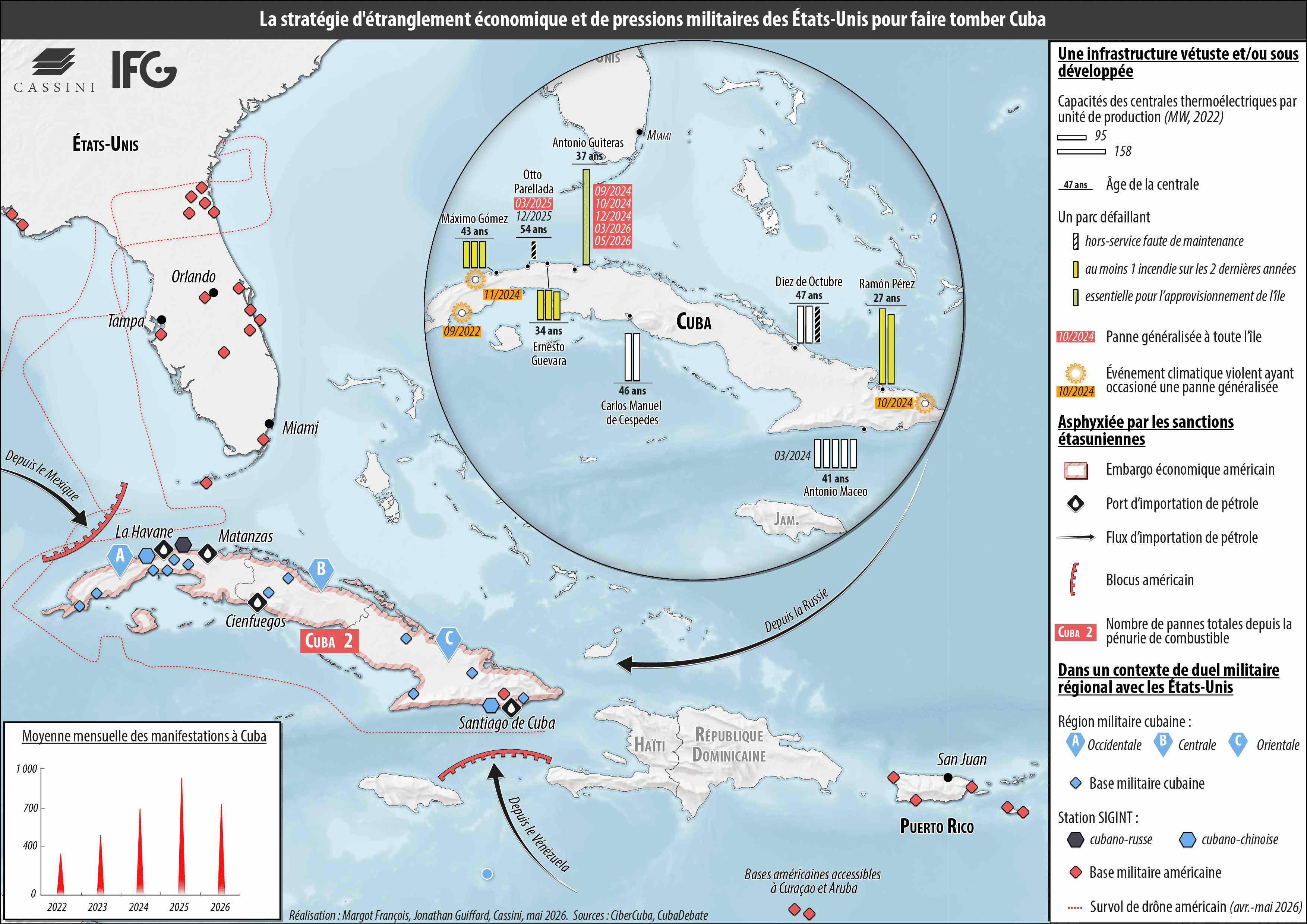
The executive order signed by Trump on 29 January, threatening tariffs on any country delivering oil to Cuba, then forced Mexico to suspend its shipments, before Cuban reserves ran out in mid-May. At the same time, military activity around the island increased, as shown by overflights of American drones. Since then, Marco Rubio has been orchestrating a campaign of unprecedented scale against his parents' country of origin. According to a count by Axios, the administration has taken two dozen separate measures against the island, sanctioning around forty entities and at least 38 individuals. The Secretary of State embraces the logic, explaining that every time the regime devises a mechanism to slip out of the noose, Washington rushes to tighten it again. The latest salvo, on 3 September, provides a telling illustration. It targets in particular Fidel Ernesto Castro, grandson of Raúl Castro, and Abapet, the company responsible for importing the spare parts essential to the power grid, precisely the weakest link in the Cuban system. To tighten the vise around the island, Washington is also using its military capabilities in the area by intensifying aerial surveillance campaigns.
It is in this context that the report published on 20 July by the State Department under the title "Cuba, Capital of 21st-Century Communism" should be read. Around a hundred pages long, the document portrays the island as a permanent enemy, committed to destroying the West by spreading Third-Worldism, and counts among its relays in the United States a series of left-wing organizations, from the Democratic Socialists of America to anti-ICE movements. Administration officials acknowledge that the text is laying the groundwork for new actions against Cuba, though Rubio declines to specify what they will be. The report in fact extends the security rhetoric already present in the January decree, which cast Cuba as a platform serving Russia, China or Iran. It adds a domestic political dimension, ahead of the midterm elections, by equating in advance any challenge to the policy pursued against Cuba with an influence operation by Havana.
The paradox of this strategy lies in the dependence it has created. In the first half of 2026, US fuel exports to Cuba reached 96 million dollars, more than half of it in June alone, as US distributors take the place of ruined Cuban state companies. The regime is trying to loosen the grip by giving ground. In early August, the Prime Minister announced a raft of 176 measures to liberalize the economy, the broadest opening to the private sector since 1959, which Rubio immediately dismissed as a cosmetic reform designed to buy time.
For the US wager is above all about time. Rubio asserts that Cuba will not find a new strategic ally in the next two and a half years, and says he is convinced that by the end of the term, the island will be on an irreversible trajectory. The military option has not been ruled out, but it now appears secondary to a stranglehold that is working. The cost, meanwhile, is borne by the population. Even when the grid holds, outages exceed thirty consecutive hours in several regions and sometimes last several days in the provinces, also complicating access to running water in cities¹⁰. The energy crisis has turned into a health and humanitarian crisis, mortality, particularly infant mortality, is rising, and the rest of the world is quite silent about the consequences of these unilateral sanctions, whose avowed aim is to asphyxiate an entire country.