
Russia's Bid to Control Africa's Resources
Sanctions, shell companies and mining ambitions: Russia's African model under strain since the invasion of Ukraine
Is Russia Losing Its Grip on Africa's Natural Resources?
This map looks at the shifting Russian model of resource extraction in sub-Saharan Africa. Since the 2000s, Russia's interest in African natural resources has served a dual purpose: securing access to raw materials essential to its industry, and restoring its status as a great power. In pursuing this, Russia could draw on the reactivation of historical ties with the Soviet Union's former partners.
A Two-Faced Model of Mining and Energy Extractivism
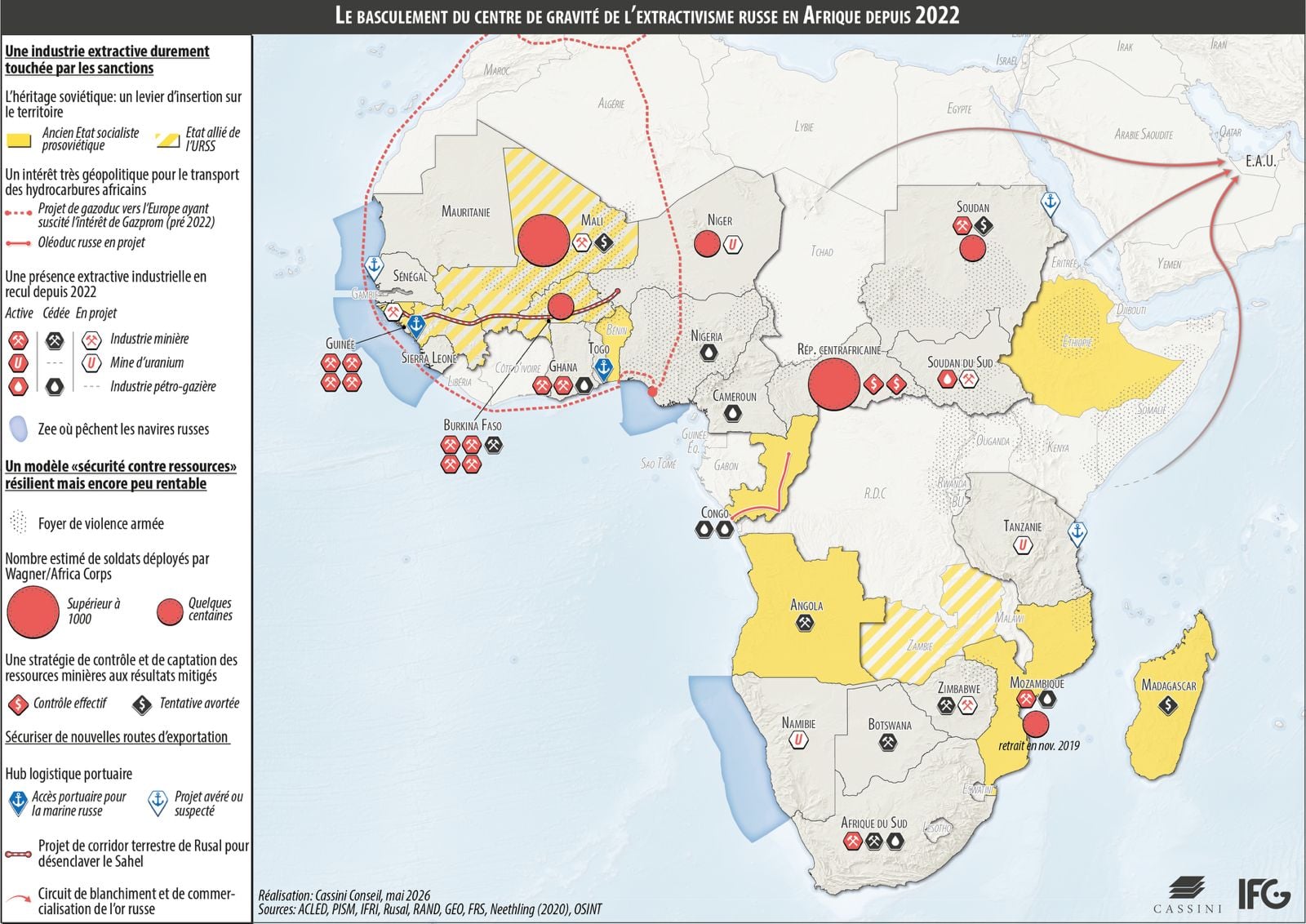
With the backing of Russian banks and a transactional diplomacy focused on acquiring resources, Russian companies have gradually built up their mining and energy portfolios in sub-Saharan Africa. In return, these companies — whether state-linked or controlled by oligarchs close to the regime — have become vehicles of influence over African elites.
This intertwining of resource extraction and geopolitical ambition is reflected in the influence strategy Moscow deployed in the late 2010s. It relied on an opaque web of intermediaries, the former Wagner network, offering security and political assistance to weakened regimes in exchange for a cut of mining revenues. This model, which favored plunder over building genuine industrial value chains, only fully developed in the Central African Republic, and with limited economic benefits for Moscow.
A Balance Reshaped by the 2022 Invasion of Ukraine
Western sanctions have weakened major Russian companies, which have become untouchable for many international partners, forcing some to sell off their African assets. Those that stayed had to restructure their operations to limit the fallout. As a result, gold extracted from African soil — essential to the Kremlin's war economy — now passes through an opaque network of shell companies, often based in the United Arab Emirates, before being sold on international markets.
Despite announcements of new projects and economic partnerships, the Kremlin is struggling to hide its limited room for maneuver. Moscow works mainly with the continent's most isolated states, such as South Sudan, where Russian offers remain attractive for lack of any alternative.
At the same time, Russia appears to be working toward industrializing the assets it inherited from the former Wagner network — a goal that is difficult to achieve without robust logistics chains to open up these resources. New fishing and port agreements signed in West Africa could represent a step in that direction. That said, recent security setbacks suffered by the Malian junta and its Russian allies are already weakening the most advanced project to date: a gold refinery on the outskirts of Bamako.