
Syria After Assad: A Transition Under Pressure
Caught between shifting regional alliances and deep internal fragilities, Syria's new leadership is walking a tightrope.
Syria After Assad: A Transition Under Pressure
A Tightrope Walker in a Region at War
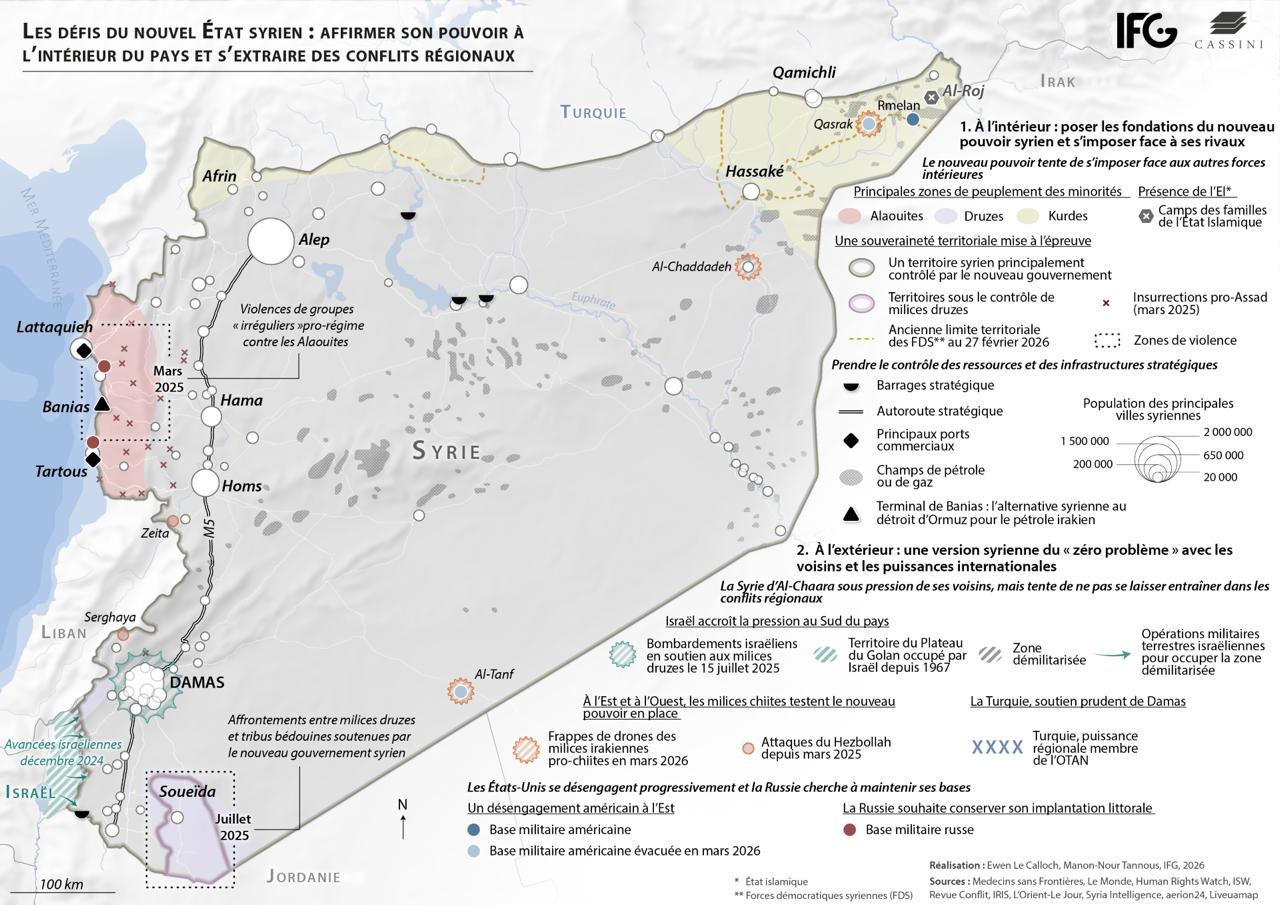
Since the outbreak of the war against Iran in late February, interim president Ahmad al-Charaa has been working to keep Syria out of regional conflict. While his territory is being targeted by Iraqi Shia militias seeking to destabilise a government that has withdrawn the country from the "axis of resistance," and while Syrian airspace is being used by Israel to carry out strikes against Iran, Syria has continued the balancing act it has pursued since the change of regime in December 2024.
Offering a Syrian version of a "zero problems" policy with both neighbours and international powers, Ahmad al-Charaa has been making a series of foreign visits, now made possible by his removal from the blacklists of individuals designated as terrorists. These meetings are aimed above all at securing financing for reconstruction and the difficult revival of the Syrian economy, which the population has been hoping to see restart nearly a year and a half after the fall of Bashar al-Assad. Western countries through the lifting of sanctions, as well as Turkey and Saudi Arabia, all appear to be betting on a successful Syrian transition, though expected investments continue to be delayed. Meanwhile, visits to Moscow illustrate the necessity of not alienating Putin, who granted refuge to his former ally Assad but intends to maintain a presence in the country. The contradictory web of alliances the new Syrian leadership is attempting to build reflects an awareness of its own fragility — made equally apparent by its inability to respond to Israeli attacks and advances on the Golan Heights.
A Society Between Political Aspirations and Rising Tensions
The effects of these international efforts are being closely watched by Syrian society, which is waiting to see the country restart. After fifty-four years of Assad authoritarianism and fourteen years of civil war, society is pulled in two directions: a strong desire to participate in the political decisions that will shape its future — every controversial decision is met with protests — and an intensification of communal and other tensions rooted in the previous regime, the war, and the difficulties of the transition.
These tensions erupted with particular pain in 2025, during the massacres of Alawites on the coast and of Druze in the south of the country. The atrocities committed and the slow pace of accountability have undermined trust in the transitional government, which is also expected to demonstrate greater political openness. The promised national dialogue has yet to take place, civil society remains excluded from power, and the legislative elections of October 2025 did little to reassure observers about the political and communal diversity of the representatives entering Parliament.
The Kurdish Question and the Security Challenge
At the same time, American backing has allowed the government to retake the majority of territories that had come under Kurdish governance during the war, on the basis of a political agreement granting unprecedented rights to Kurdish populations — recognised as a component of Syria — in exchange for the integration of their military forces into the national army, as well as the transfer of control over resources (notably oil), borders, and prisoner camps housing in particular Islamic State fighters.
The fate of these detainees is being closely monitored by Syria's international partners, concerned about global security and attentive to the new government's capacity to effectively combat terrorism and assert control over the entire territory. This cartographic analysis aims to shed light on both the internal and international stakes of the Syrian transition.