
China's bid for control of Europe's power grid
Chinese energy and tech investment in Europe: opportunity or vulnerability?
Chinese energy and technology investments: opportunity or vulnerability for Europe?
While China has been investing in Europe's energy sector for over a decade, a recent surge in this foreign direct investment has shifted away from major industrial countries (Germany, France, the United Kingdom) toward more peripheral states, such as Spain or Serbia.
This investment is particularly focused on electricity transmission grid operators. Chinese state-owned enterprises, most notably the State Grid Corporation of China (SGCC), a global giant in the sector, have sought to acquire stakes in seven European companies in this field, with four successful operations (Portugal, Greece, Italy, Luxembourg). For Beijing, the stakes were twofold: acquiring know-how useful for modernizing its own grid, and promoting its technological standards.
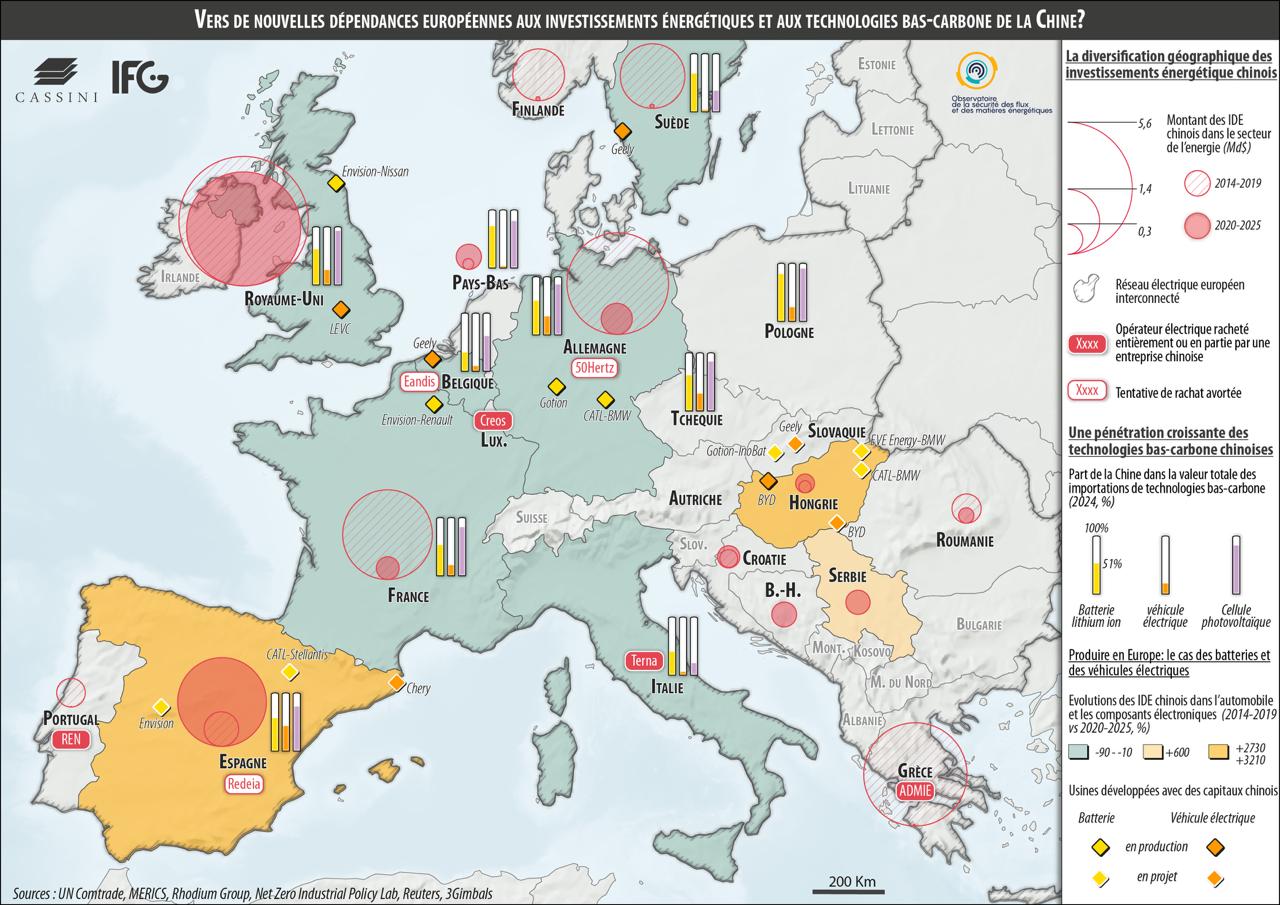
Beyond capital flows, Europe is also seeing an influx of Chinese technologies intended to support its energy transition. Thanks to massive subsidies granted by Beijing, Chinese "green" technology products are particularly competitive and have taken the European market by storm. Across Europe, 70% of photovoltaic cells are now imported from China, along with 57% of lithium-ion batteries and 18% of electric vehicles. Yet some of these technologies integrated into the European electricity grid, such as photovoltaic inverters, come equipped with "smart" devices whose data is stored in China, raising concerns about confidentiality and sovereignty.
Faced with this industrial competition deemed "unfair" by the European Commission, the EU established customs tariffs on electric vehicles imported from China in October 2024. As a result, Chinese companies in the sector are increasingly investing to produce directly in Europe. Initially concentrated in traditional automotive industry hubs, this investment has gradually shifted toward countries on the European periphery, particularly Spain and Hungary. We have identified at least 19 battery or electric vehicle factories built, repurposed, or financed with Chinese capital, of which 9 are now in production.
The establishment of carmaker Chery at the former Nissan site in Barcelona was hailed by Pedro Sánchez as a "symbol of the reindustrialization process of Catalonia and Spain." But these investments also strengthen China's grip on low-carbon technology value chains, risking a lasting loss of European control over its own energy transition. This did not stop the Spanish head of government from announcing, during his visit to China in April 2026, his intention to strengthen the bilateral economic relationship in order to accelerate investment in low-carbon technologies.