
How Hello Tractor is closing food security gap in Africa
Mechanising African farms to grow more food, stronger livelihoods, and healthier communities
How Hello Tractor is closing the food security gap in Africa
Food security in Africa is not just about seeds or fertiliser. It starts with the ability to farm efficiently. Hello Tractor was built on one powerful insight: Africa has the most arable land in the world yet the least access to mechanisation. Through a smart booking platform, trusted local agents, women-led hubs, and AI-powered crop advisory, Hello Tractor has built an ecosystem that improves farm productivity, household incomes, and access to nutritious food across the continent.
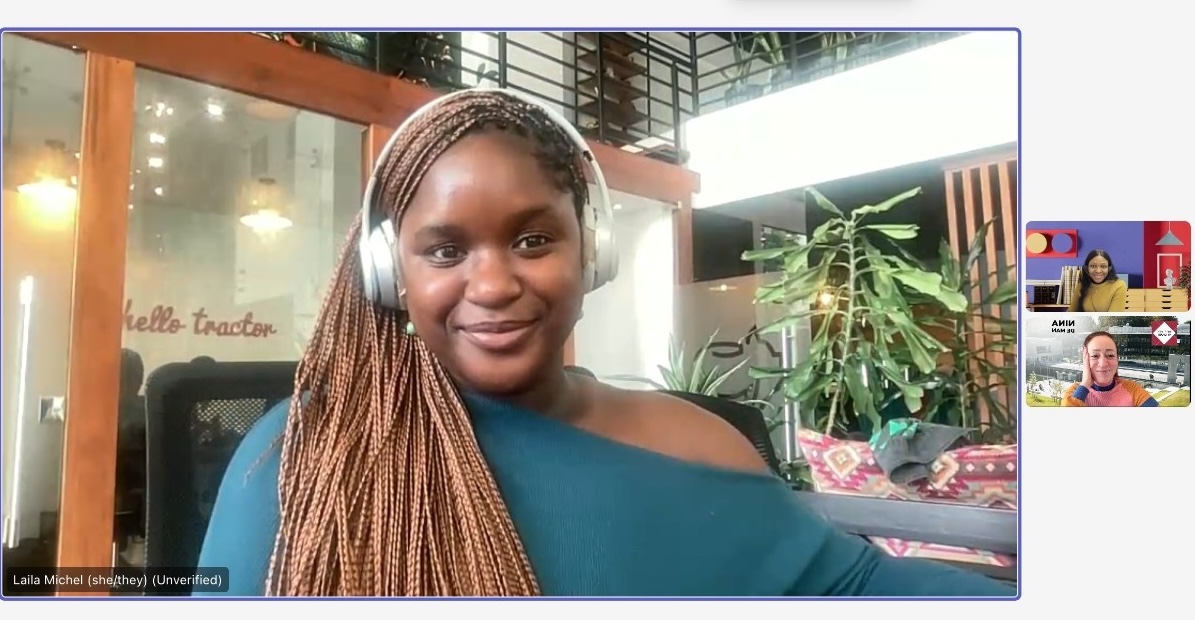
In this conversation, Chidera Arum, our Strategy Analyst at the Centre for Net Positive Business, and our editor-in-chief Nina de Man sit down with Laila Michel from Hello Tractor to explore how this model works and what it means for the future of food security in Africa.
At a recent UNESCO event in Paris, the conversation kept circling back to AI, disruption, and what it means to remain human. How does Hello Tractor sit within that conversation?
I really appreciate the nuance you’re pointing to. In my circles, people are also nervous about AI in fields that feel uniquely human – music, literature, cultural production. I share that concern. I think those spaces should remain as human as possible.
Where I do see real value is in innovation, science, technology and teaching. At Hello Tractor, we’ve found ways to integrate AI that feel genuinely helpful, without undermining human connection – which is what our model relies on.
Right now, we use language models to turn hyper-local weather forecasts into localized digital advisory for farmers. Kenya has many microclimates: you can drive 20 minutes and go from heavy rain to dry sun. When you extend that to rural areas, the stakes are even higher – you can’t just give a “25-acre forecast” and expect every farmer to behave the same way. Farmers already know the weather; what they often don’t know is what to do with it. Our chatbot takes those hyper-local forecasts and translates them into specific advice for their crops. That doesn’t replace anyone’s job because, frankly, there aren’t enough people to read the weather across 20-something counties, every five acres, and then text every farmer with tailored advice.
So for us, AI fills gaps where:
- There is no human capacity to do that work at scale, and
- It would be unreasonable to assign that level of repetitive “drudgery” to a person.
We’d rather have our people out in the field: engaging with farmers, coordinating services, working on frontier innovations like drones, biofuels and electrification. That’s the kind of AI use I believe in: doing the jobs humans shouldn’t be doing, so humans can focus on what only they can do.
Let’s go back to the beginning. What was the original challenge the founder of Hello Tractor wanted to tackle? Where did the idea start?
The starting point was very clear: the mechanisation gap in African agriculture.
Our founder, Jehiel Oliver, used to show two pictures in his pitch deck. One was from 2,000 years ago: ancient Egyptians using an ox and plough. The other was a recent photo from Kenya showing a farmer using… an ox and plough.
His point was:
Nowhere else in the world are people still using techniques that are literally thousands of years old at this scale.
Africa has the most arable land in the world, but the least access to mechanisation. Farming is the number one occupation on the continent, yet the ability to earn a decent livelihood depends heavily on how efficiently you can farm.
Without mechanisation, it can take:
- three weeks just to plant,
- four weeks to harvest,
- and you risk missing the rains or the optimal harvesting window.
Jehiel compared tractor density globally – in places like North America, Asia, Latin America – versus Africa. For every 20–30 tractors per unit of land in some regions, African farmers might have one or two.
So while many people talk about seeds, fertilizer or finance, he realised a fundamental truth: If farmers can’t farm efficiently, none of the other support fully translates into sustainable livelihoods.
The core insight was: closing the mechanisation gap is one of the most powerful levers to move African agriculture toward productivity, resilience and food security.
So that’s the insight. What did he actually do next?
He started in Abuja, Nigeria. At that time, countries like China and India had already gone through their agricultural revolutions and were sitting on a surplus of tractors and spare parts.
Jehiel saw:
- a surplus of machinery in one part of the world,
- a shortage in another.
He built business pipelines and partnerships to move machinery to African markets.
Then he created the basic structure:
- A fleet management device on each tractor so owners can track usage.
- An app for tractor owners, so they can manage their asset.
- An app for booking agents – trusted local people within rural communities.
Booking agents are crucial. Farmers are constantly promised things that never materialise. If a stranger says, “I’ll bring a shiny tractor in two days,” they don’t believe it. So Hello Tractor works with people already trusted in the community – often young people and many women – who:
- know the farmers personally,
- are a bit tech-savvy,
- and want to change what rural livelihoods can look like.
Booking agents visit farms, collect data (size, crop type, service needed, preferred timing) and upload it via the app. At HQ, a customer success team verifies bookings and aggregates demand so tractors can be routed efficiently.
In the beginning, there were challenges: mismatches between acres booked vs acres actually serviced, delays, breakdowns far from any infrastructure. That’s where the idea of hubs came in.
People often describe Hello Tractor as “Uber for tractors.” Where does that analogy hold, and where does it break down?
The Uber analogy is a useful entry point – it’s how Jehiel explained the model to me when I joined:
“Think of it like Uber, but for tractors.”
But once you’re on the ground, you realize tractors are not cars, and tractor operators are not just drivers.
You need to:
- train operators,
- train technicians,
- build physical hubs where farmers and tractor owners can come,
- and design for gender inclusion and youth opportunity.
Our hubs are like bright orange shipping containers in rural areas – part truck stop, part community centre, part demonstration site. Farmers can:
- see implements in action on demo plots,
- learn about new practices,
- meet agronomists,
- and access inputs (seeds, fertilizers, etc.) from partner companies.
So yes, there is a “platform + matching” element similar to Uber. But there’s also:
- physical infrastructure,
- training,
- community-building,
- gender strategy,
- and climate strategy.
It’s an ecosystem, not just an app.
You mentioned women earlier. Was inclusion part of the strategy from the beginning? How did you address that?
A lot of our leadership is female, so gender inclusion was never an afterthought – it was a lived reality from early on. But we did see the need to be more intentional as we grew. Initially, our candidate pools for roles like tractor operators, technicians, etc., were overwhelmingly male. That reflects broader patterns: many men leave rural areas for the city, leaving women with childcare, manual labour and often the actual farming. Yet heavy machinery, repair work, and similar trades tend to attract men first.
When our internal numbers began to skew, we created a gender strategy for the entire business model. Some concrete steps:
- Women-only tractor operator training
- Women-only technician teams
- A high proportion of female hub coordinators and leaders
Because many hubs are managed by women, female farmers and young women feel more welcome. They see themselves reflected in the space. It helps counter the narrative that rural mechanisation or agricultural technology is “just for men.”
We also deliberately focus on youth and women because:
- They are heavily represented in rural communities.
- They are particularly vulnerable to the impacts of the climate crisis.
- When women’s livelihoods improve, entire communities benefit.
René often talks about catalytic effects and tipping points – how one good idea triggers transformation across a whole system. Beyond mechanisation, how is Hello Tractor changing things like soil health, biodiversity, and long-term resilience?
We realised very early that giving farmers access to tractors isn’t enough. Many smallholder farmers:
- contribute least to climate change,
- but are among the first to experience its effects.
So we can’t just drop technology into that context and walk away. We built climate-smart agriculture into our approach from the start, focusing on three core practices:
- Minimal or no-tillage ploughing
We try to disturb the soil as little as possible to keep carbon in the soil, not in the atmosphere, and to maintain nutrient density. If you tear everything up, you destroy much of the value you’re trying to build. - Soil cover / crop cover
We teach farmers to keep soil covered – through crop residues, mulching, etc. Many also raise livestock, so we encourage them not to over-strip fields but to maintain cover that protects and enriches the soil. - Crop rotation and crop diversity
With manual labour, farmers often have to choose: do they focus on the long rainy season and rest during the short one? With mechanisation, they can farm both seasons and diversify. Different crops put in and take out different nutrients; rotation avoids exhausting the soil by repeatedly extracting the same ones.
At each hub, we have agronomists and demo plots to show these practices in action, using implements like potato planters and harvesters. Because these tools are new and expensive, farmers need to understand why they’re valuable – not just financially, but in terms of long-term soil health, reduced disease and lower pesticide use. We also partner with input providers (seeds, fertilizers, pesticides) who join events, often selling at reduced prices. That makes the hub a kind of one-stop shop for resilience: technology, inputs, and knowledge.
In the future, we’re working towards:
- Electrifying tractors
- Using biofuels grown from indigenous crops
- Creating a circular value chain where farmers grow the feedstock for our fuel, and we share carbon credit benefits back to them (e.g. as discounts on services)
That’s the frontier of our climate strategy – and it’s very exciting.
Where is Hello Tractor active today?
In terms of offices, we’re present in: Nigeria, Kenya, Rwanda, Ethiopia, Uganda
Across these, we currently have around 18 hubs, and we’re aiming for at least 30 by the end of next year. In terms of traction on the ground – where tractors are operating or booking agents are active – we’re present in about 18 countries. So the mission is scaling, but the model must localise wherever we go.
We’re working on “healthy, accessible nutrition” as a research theme. Do you have impact statistics on how Hello Tractor affects household food security, income, or nutrition?
We’re a very data-driven company, so yes, the numbers exist – though I don’t have them all in front of me. Recently we commissioned a research institution that works in Swahili to interview Kenyan farmers and tractor operators.
What stood out were the stories:
- Tractor operators talking about finally being able to pay school fees and manage their debts more comfortably.
- Booking agents earning commissions and building new careers.
- Technicians and hub staff gaining stable jobs in rural areas.
When people think of impact, they often focus only on the farmers. But the Hello Tractor ecosystem includes:
- Farmers receiving services
- Tractor operators earning income
- Booking agents receiving commissions
- Technicians employed at hubs
- Hub staff and coordinators, often women, leading local operations
- Champion agents managing and mentoring booking agents
So the livelihoods impact is spread across the entire value chain. Hubs, in particular, have created lots of jobs. I’m happy to share more detailed stats later – but qualitatively, we see strong improvements in household income, stability and opportunity.
You’ve already hinted at some challenges. What are the biggest obstacles when scaling this model across the continent?
The mission can scale; the model has to localise.
Africa is huge, and every region is different – culturally, socially, agriculturally. Some examples:
- In one community, we had to change a hub manager because he was from a different tribe than most farmers. They didn’t trust him, and they wouldn’t come. If you don’t understand local dynamics, this just looks irrational. If you do understand them, it makes sense.
- When we launch a new hub, we have to think carefully: Who do we hire? Are they embedded in the community? Are they “community favourites”? Do people see them at church, weddings, baby showers? That social fabric matters as much as any technical skill.
- Practical issues come up: land rights for hub construction, mismatched expectations, logistical constraints, even theft of tractors in the early days. Instead of reacting only with punishment, we asked: “What is it about our model that makes someone want to steal the tractor rather than keep it in our ecosystem?”
The answer was often: “We’re not making enough money.”
So we developed a Pay-As-You-Go tractor financing model, allowing high-performing operators to gradually become owners.
All of this requires patience, humility and listening. You can’t impose a neat, Western-style business model on rural communities and expect it to work. If you say you want to “serve farmers,” you have to understand farmers: what they grow, how they live, who they trust, what their climate challenges are. And that can change every 20–30 kilometres.
When we get it right – like at our new Narok hub, which had record attendance at its launch – it’s because we’ve:
- done the research,
- targeted our campaigns,
- hired the right people,
- and aligned the offer with local realities.
Those are the big challenges – and the most rewarding ones when we manage them well.
How has working with Hello Tractor changed your own attitude towards food and nutrition?
It has completely reframed it.
In the US, many people are detached from where their food comes from. Even when I studied environmental development, I learned a lot about systems – climate policy, food systems, international development – but not necessarily about the individual people behind those systems. California, where I did my master’s, was my first glimpse of a more immediate relationship to food: fruit trees in the street, farmers’ markets, local produce.
Hello Tractor took that further. It introduced me to the farmers themselves:
- Visiting their fields
- Hearing about their constraints and hopes
- Seeing how a service like ours fits into their lives
Now, when I go to the market and see a product labelled from a region like Narok, I don’t just see “produce”; I see actual people I know, and the ecosystems they rely on. It has made the humanity of food systems non-negotiable for me. You can’t separate the business model from the people. The model simply doesn’t run without them. My education at Berkeley gave me tools to think about systems. Kenya has taught me to see and value the people within those systems. The combination of both feels incredibly powerful.