
Greenland in Washington's Crosshairs
Between the Chinese Threat and the Race for Raw Materials: Deciphering a Multifaceted Arctic Issue
Greenland in Washington's Crosshairs: Chinese Threat or Race for Raw Materials?
The Security Argument: A Limited Chinese Presence
January 2026. Donald Trump reiterates his insistent desire to acquire Greenland, the world's largest island — 2.16 million km², 81% of which lies under ice, home to only around 56,000 inhabitants. This vast white wilderness would be, for the United States, a "national security priority" in the face of China. Yet cartographic analysis nuances this rhetoric and shows that American motivations are as much geological as geostrategic.
The White House highlights a supposed "Chinese omnipresence" in the Arctic. It is true that Beijing has strengthened its capabilities, declaring itself a "near-Arctic state" and promoting a "Polar Silk Road." But the contrast between the narrative and reality is stark: China has only three icebreakers, compared to Russia's fleet of over forty vessels. More importantly, its physical presence on Greenlandic territory remains modest. Investment attempts have largely failed — in some cases due to intervention by the Danish government (the airports of Nuuk and Ilulissat, and the naval base at Grønnedal). Meanwhile, the United States already holds a consolidated position with the Pituffik base, and existing agreements could allow them to expand that presence further if deemed necessary.
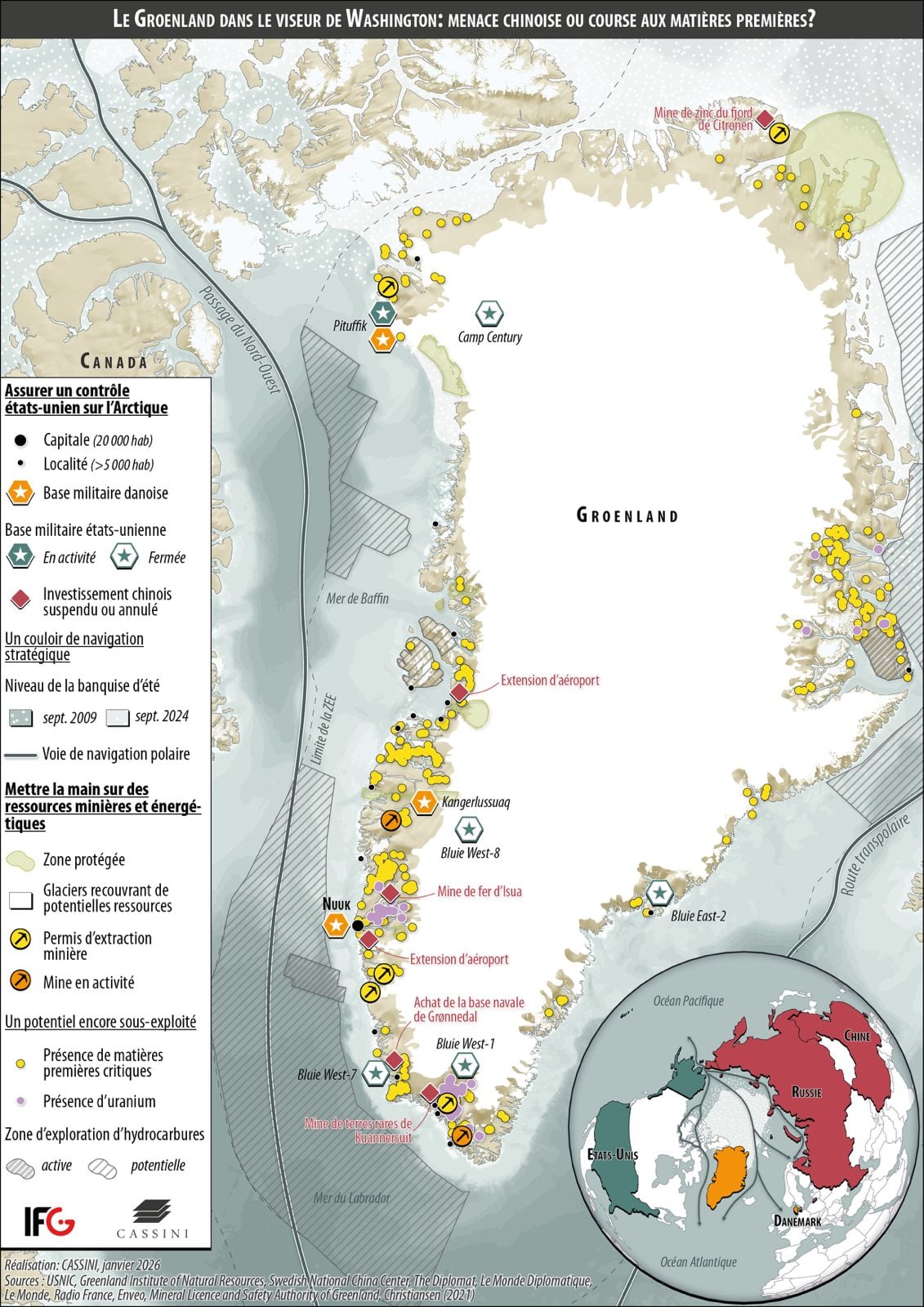
A Climate "Opportunity"
Climate change is reshaping the playing field. Between 1979 and 2024, the extent of summer sea ice shrank by roughly half, freeing up coastal areas and facilitating access to previously unreachable territories. The retreat of the ice also opens a wider window onto Arctic corridors: the Northwest Passage can save up to two weeks compared to the Panama route, while the Northern Sea Route cuts the Asia–Europe journey in half. In this context, controlling Greenland — with its more than 44,000 kilometres of coastline — means positioning oneself at the gateway to a space that could become both a commercial artery and a frontier for the extraction of hydrocarbons and minerals.
The Mining Imperative
While the Chinese "threat" is front and centre, it is above all Beijing's economic dominance over critical materials that causes concern. With China controlling roughly 90% of global rare earth refining and constraining the United States through export quotas, Washington is seeking to break this monopoly — notably by investing in domestic capacity (Mountain Pass, Vulcan Elements, ReElement Technologies). In this regard, Greenland hosts 25 of the 34 minerals classified as critical by the European Union, including rare earths, graphite, cobalt, and copper. Its rare earth reserves are estimated at 1.5 million metric tonnes — comparable to those of the United States and greater than those of Canada — with deposits such as Kvanefjeld rich in neodymium, dysprosium, and terbium.
That said, Greenland has no roads connecting its settlements, its port infrastructure is limited, and only two mines are in operation across its entire territory. Furthermore, the revocation of licences such as that of Kuannersuit has eroded investor confidence. Under these conditions, analysts estimate a ten-to-fifteen-year horizon and an investment of several billion dollars before any rare earth project reaches the production phase. And even then, the extracted ore would need to be sent to China for processing, given the Chinese monopoly on refining capacity.