
The Strait of Hormuz Under Tension
When the Global Oil and Gas Artery Becomes the Theater of a Standoff Between Iran and the West
The Strait of Hormuz: Permanent Tension on the World's Oil and Gas Artery
The Strait of Hormuz: A Vital Artery at the Heart of the Planet's Oil and Gas Supply
On Saturday, 28 February 2026, Israel and the United States launched a large-scale military campaign against Iran. In response, the Revolutionary Guards — the armed wing of the Islamic Republic — announced the "de facto" closure of the Strait of Hormuz. A few hours later, Iran claimed, via state television, an attack on a tanker it accused of having crossed the strait "illegally."
Our map shows that these recent events are part of a long series of tensions crystallising around the Strait of Hormuz, a vital space for global hydrocarbon trade.
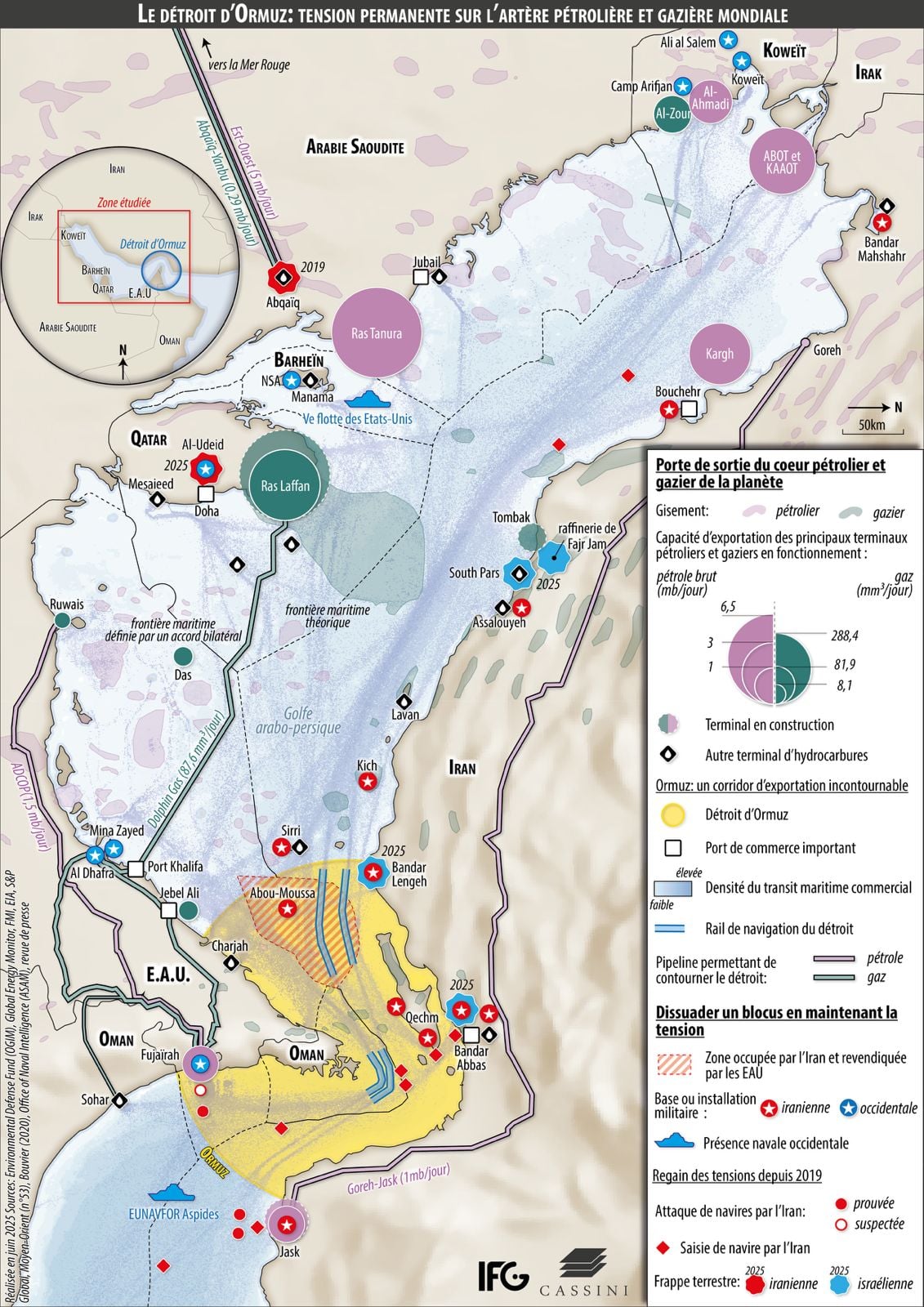
The Strait of Hormuz: Permanent Tension on the World's Oil and Gas Artery
Barely fifty kilometres wide at its narrowest point, the Strait of Hormuz is the only maritime passage connecting the Indian Ocean to the Arabian-Persian Gulf. The countries bordering this near-enclosed sea are among the world's leading producers of crude oil and natural gas, with Saudi Arabia, Iraq, and Qatar at the forefront. This maritime space is therefore dotted with vast energy complexes for exploiting offshore deposits, as well as export terminals (shown as purple and green circles). The constant flow of tankers and LNG carriers transiting the area is naturally directed towards the only possible exit: the Strait of Hormuz. In order to illustrate the "funnel" role played by this maritime passage, we have chosen to take certain liberties with cartographic conventions by orienting the map not towards the north, but towards the east. In 2024, approximately one fifth of all liquefied natural gas and more than a quarter of all seaborne oil transported globally passed through the Strait of Hormuz, with Asia as the principal destination.
Transit Through the Strait: A Lever for Negotiation and Disruption for Iran
The Sultanate of Oman and the Islamic Republic of Iran share sovereignty over the strait in equal parts under a bilateral agreement dating from 1974. For security reasons, maritime traffic is concentrated on two deep-water lanes along the Omani coast before entering Iranian waters (blue corridor). Since Iran does not recognise the international character of the strait, it considers itself entitled to intervene there, or even to restrict or close access when it deems it necessary. Since the 2000s, Tehran has strengthened its capabilities in the area and now possesses a rapid naval intervention force, based primarily in Bandar Abbas, as well as ballistic capabilities, notably on the disputed island of Abu Musa, controlled by the Islamic Revolutionary Guard Corps.
Although the Islamic Republic has already seized Western tankers (shown as red squares on the map) and brandished the threat of closing the strait — most often in reaction to sanctions targeting its hydrocarbon exports — it has never, to this day, followed through: virtually all of its own oil exports pass through that same passage. Nor does it have the means to establish maritime supremacy there in the face of Western forces stationed in the Gulf, which have been considerably reinforced over recent weeks.
Limited Overland Bypass Capacity in the Face of an Escalation Risk
That said, there is no need for a full naval blockade to disrupt navigability in the strait. Since 2018, acts of sabotage and drone attacks attributed to Iran had already raised fears of an escalation in the strait (red circle). The particularly volatile current security environment, compounded by rising maritime insurance costs, could render the strait unnavigable in the short term. Yet alternative routes are limited. With the exception of Iraq, all of the region's major producers have constructed pipelines allowing them to bypass the strait (shown as purple and green lines). However, these infrastructures are not dimensioned to absorb the full redirection of maritime flows. Moreover, these overland installations are themselves prime targets in any scenario of military escalation. It is worth recalling that in 2019, the Petroline pipeline (Saudi Arabia) was the target of an attack claimed by the Yemeni Houthis, allies of the Iranian regime.
While the outcome of the current conflict remains highly uncertain, this cartographic analysis helps us understand that it will in all likelihood have repercussions on the global hydrocarbon market.