
Kersia Group and EDHEC Executive Education: a partnership to develop talent in a context of hypergrowth
In a context of rapid international expansion, the Group HR Director of Kersia chose a customised programme from EDHEC to rethink how the organisation supports its managers and high-potential talents.


An international player in food safety, the Kersia Group has experienced exceptional growth, expanding from 400 to more than 3,200 employees in less than ten years. To support this global transformation, Group HR Director Guillaume Tanter initiated the co-construction with EDHEC of a Talent Management programme.
This initiative places leadership, innovation and skills development at the heart of the Group’s performance and managerial transformation.
What was the trigger for launching a bespoke programme dedicated to your talents?
Between 2016 and 2020, we had already implemented several structured programmes focused on management and interpersonal communication. However, the Group’s hypergrowth very quickly revealed new limitations: our managers were required to lead increasingly large teams in a context of constant change.
Following an in-depth review of our succession planning, we realised that we needed a programme capable of supporting our managers in taking a step back and managing change, while developing both their hard skills (finance, innovation, strategy) and their soft skills, which are essential to engage, inspire and grow their teams.
We were looking for a bespoke programme, fully aligned with our operational reality and with the challenges of an organisation expanding internationally.
Why did you choose to co-construct this programme with EDHEC?
The choice of EDHEC became quite natural, for two main reasons.
The first was the alignment of values. We share strong convictions with EDHEC: innovation, commitment and impact, but also pragmatism. Within the custom programme team, we found what we experience every day at Kersia: Sharing, Transparency, Foresight and Proficiency.
The second reason was the pedagogical quality, which is truly best in class. We were looking for a school capable of combining academic excellence, a strong understanding of the international context and a very concrete approach to business. EDHEC does not train for theory, but for impact.
From the very first exchanges, we felt a natural connection between our two cultures. This partnership was built on trust and co-construction.
How is this Talent Management programme structured?
It is a bespoke programme designed for our managers and high-potential talents. It combines academic learning, leadership workshops, finance and innovation modules, and above all the “Impact Challenges”, which are genuine transformation projects led by the participants.
Each cohort brings together around twenty participants from several countries, supported by EDHEC faculty members and sponsored by members of our Executive Committee. The Impact Challenges make it possible to work on real business issues and to deliver concrete results for the organisation.
What tangible impacts have you observed since the programme was implemented?
The changes were visible very quickly. Our leaders gained in leadership posture, perspective and influence. They moved from a control-based approach to a more inspiring management style, guided by a shared vision, our “North Star”, which steers us towards collective performance.
The projects carried out as part of the programme also delivered measurable strategic impacts. For example, the redesign of our offering model, with a solutions-oriented rather than product-oriented approach; and the implementation of a post-acquisition cross-selling methodology to maximise synergies between our different Business Units. These projects created real business value while strengthening transversal collaboration across the Group.

Drawing on your experience, what does it take for an international organisation to turn a customised programme into a real driver of transformation?
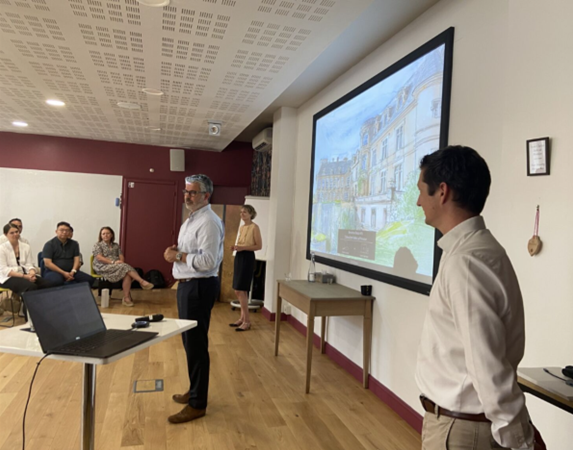
The full involvement of the Executive Committee is key to the success of the programme. It is engaged at every stage: participant selection, programme launch, project definition, juries and the final celebration. This presence gives the programme strong legitimacy and highlights the value of the talents involved.
Participants clearly see that their development is a strategic priority supported by top management. This significantly strengthens their engagement and sense of belonging.
What broader benefits have you seen for Kersia as a whole?
Beyond individual development, the programme has a strong collective impact. It supports our talent pipeline, improves managerial performance and contributes to well-being at work. Every year, we conduct an internal well-being survey, and skills development consistently emerges as one of the strongest expectations.
Thanks to initiatives such as the Talent Management programme, 93% of our employees consider Kersia to be a good place to work. This type of programme fosters a dynamic of trust and continuous progress, which is essential in a group undergoing rapid transformation.
What advice would you give to an HR Director or executive looking to launch a similar programme?
I would say: make it a company-wide project, not just an HR initiative. The commitment of top management is essential. Without it, training remains theoretical.
Then, prioritise co-construction. Working hand in hand with an academic partner such as EDHEC Executive Education is the guarantee of a solution that is both demanding, pragmatic and perfectly aligned with your business challenges.
Finally, never lose sight of what truly matters: training is first and foremost about helping the women and men who drive your organisation’s transformation to grow.
Empowering your leaders to maximise your organisation’s impact.


