

Tsugu and the power of sharing: a spring tour of four Japanese universities with Ricardo Azambuja (EDHEC)
In this article, we travel to Japan with Ricardo Azambuja, an Associate Professor at EDHEC Business School. In the spring 2026, over the course of a month, at four renowned universities – Hitotsubashi, Tsukuba, Kobe and Kyoto – he presented his research and exchanged views with dozens of scholars and PhD students.

Two men slowly climb a series of staircases surrounded by trees of various species, including magnificent cherry trees in bloom. They are heading towards a cream-coloured building with clean lines, whose half-moon windows on the third and top floor barely emerge from the foliage.
They had been in contact for over a year and a half via email and video calls before finally meeting in person: Masashi Goto, an Associate Professor at Kobe University (Japan), and Ricardo Azambuja, an Associate Professor at EDHEC Business School (France), are heading towards the Kanematsu Memorial Building, where they are about to deliver a joint seminar to an audience of around a hundred people. “It couldn’t have gone better,” recalls Pr Goto, “the topic Ricardo addressed clearly resonated with the questions many researchers are asking. His experience and recommendations proved far more interesting than we could ever have hoped for.”
Participants from all corners of Japan
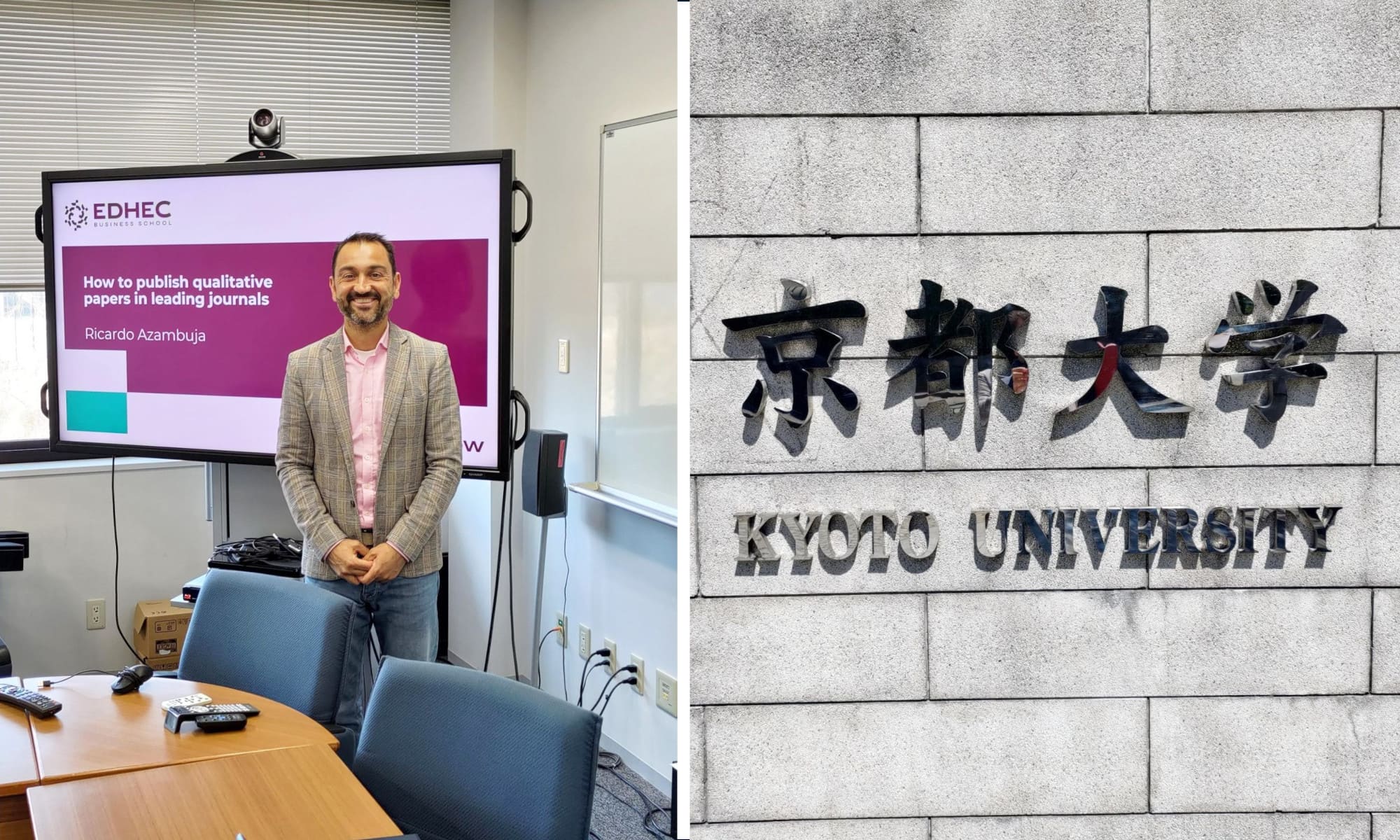
Kobe is the third stop on a long-planned spring academic tour organised with four leading Japanese universities interested in Ricardo Azambuja’s work. Hitotsubashi University had kicked things off a couple of weeks earlier, with extremely attentive hosts – professors Ivar Padrón Hernández, Masaru Karube and Satoko Suzuki – from the suburban and downtown campuses of Tokyo. Next, the tour headed to the University of Tsukuba, where professor Hidenori Sato had organised a very animated event full of engaging intellectual exchanges. The fourth and last stop was at Kyoto University with professors Yutaka Yamauchi and Jin-ichiro Yamada.
Much like mankai, the brief moment when cherry blossoms reach full bloom, that day in Kobe left Professor Azambuja with particularly vivid memories: “Having so many participants, both in person and online, for an academic seminar sparked a mixture of apprehension and enthusiasm in me. But the attentive listening and the precision of the questions allowed me to calmly present my research on how to publish articles based on qualitative data in the leading scientific journals.”
His work has indeed been published on several occasions in top journals (1), notably on topics directly related to Japanese senior partners and retirees from major auditing firms (2). After decades in which their work defined their identity, senior partners struggled to turn the page and remained attached to their former professional lives. An original research subject (the post-career lives of professionals and their reflections on lifelong devotions to a profession have been scarcely studied), a rare and difficult-to-access sample of individuals, and in-depth qualitative interviews made it possible to capture nuances, profound and rich experiences and meanings that other methods and research subjects would hardly grasp.
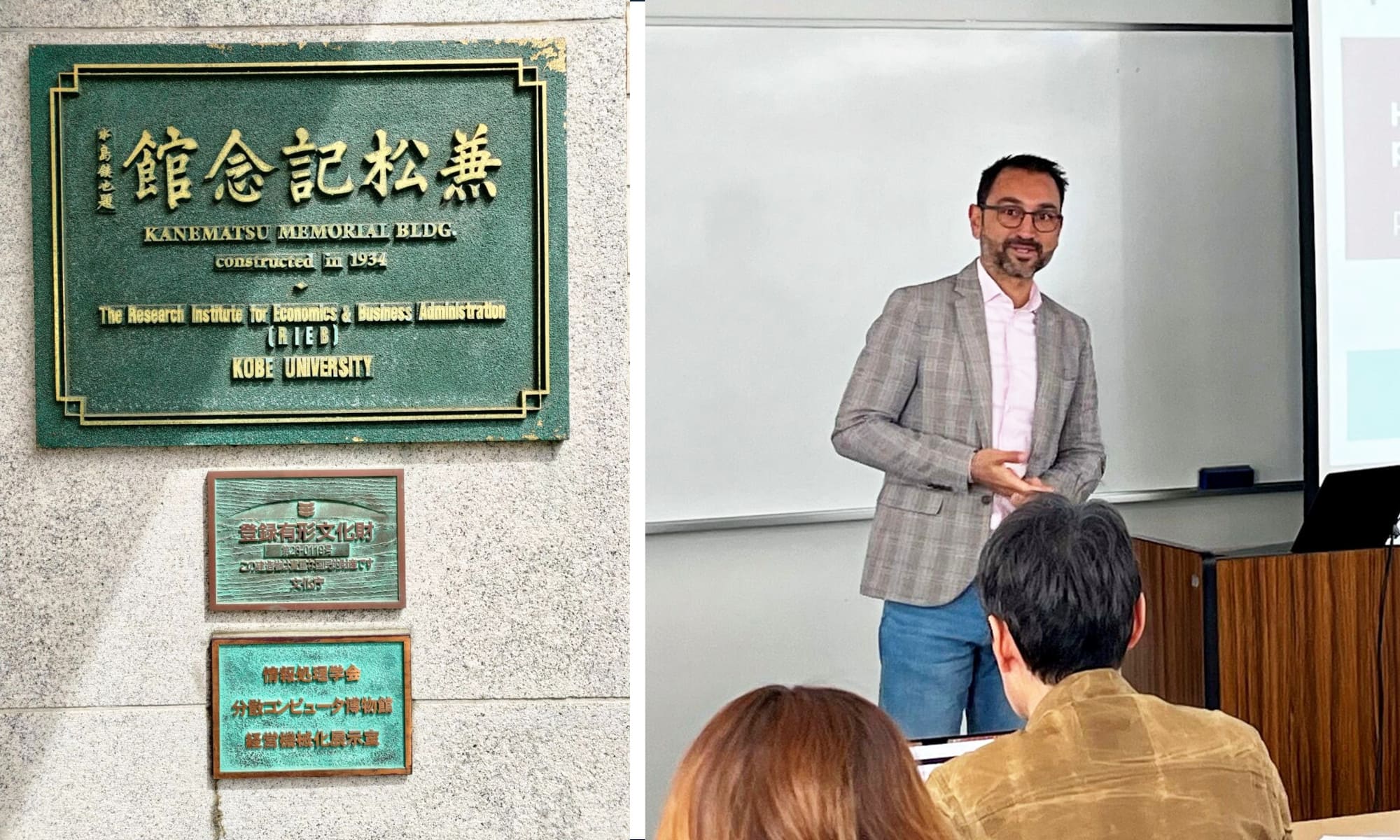
This is precisely the kind of expertise that Japanese universities are seeking to develop. For Masashi Goto, this invitation was far from coincidental: “Researchers at our universities have historically published very little in major English-language journals, as local Japanese-language journals are influential and provide visibility and dynamism in many fields. But this is changing.” The participants’ questions illustrate the shift currently underway: How should one prepare one’s data? How can one organise the sections of one’s article more effectively? How can one collaborate with international researchers?
After Pr Azambuja’s seminar, Masashi Goto presented the research on artificial intelligence and the tax accounting profession that he now co-authors with Pr Azambuja. “This is a subject that has historically been close to Masashi’s heart, explains Ricardo Azambuja, namely the broader issue of AI and the professions. For my part, I wanted to explore AI in the workplace, and we chose a decidedly original angle: that of tax accountants within small and medium-sized enterprises.” Based on the data and initial findings, they developed the framework for a paper that has since been submitted to a leading journal.
Throughout the afternoon, the dynamics of the discussions struck Ricardo Azambuja: “The participants were very engaged, but they asked few questions during my presentation. Most came at the end, during the discussion period, and even then they were more reserved than at seminars in Europe”. He initially interpreted this reserve as a form of restraint, before coming to understand it differently: “On reflection, he explains, I think that seminar participants do not want to disrupt the harmony of the presentation through overly frequent reactions or comments that might be perceived as too critical.”
In contrast to this reserve displayed during the seminar, the dozens of messages of thanks, requests for clarification or even announcements (“It’s decided – your talk has made me realise that I want to go into research: I’m starting a PhD next year!”) received by Ricardo Azambuja in the hours that followed tell a different story. He had already sensed this quiet excitement before the seminar: in the customary exchange of business cards, with a queue forming in front of Pr. Goto rather than in front of him, and with an audience arriving early so that the seminar could begin right on time. Pr. Goto concluded: “For me, there is no doubt that this presentation was a success, and it marks a turning point in our collaboration, which I know will be fruitful in the years to come.”
“A strong impression of time standing still”
Taking the tour as a whole, Ricardo Azambuja is left with a sense of serenity and fruitful contrast. How could one not slow down, indeed, at the heart of Kyoto University, in front of a temple, whilst strolling through gardens bordering on perfection, or walking along the light-coloured, silent wooden corridors? “I’m well aware that I’ve visited well-preserved and prestigious places, he says, suddenly more serious, but Japanese society clearly chooses to invest for the long term. It gives a strong impression of time standing still.”
He was struck by the discreet nature of the technology there, and by a paradox that made him smile: “Despite high levels of sophistication and complexity - and I’m not just talking about the language - everything is fluid and easy to understand at a glance: the signage, the places, the transport… Conversely, I find it very difficult to read a face, an expression or body language. This contrast has never ceased to amaze me.”
Japan, Pr. Azambuja points out, is undoubtedly the most culturally ‘distant’ country he has had the chance to explore, having lived in Brazil, France, Lebanon, Portugal, the United States and the United Kingdom.
Letting oneself be challenged by difference
The EDHEC professor sought out this ‘distant’ culture deliberately. “In my field, qualitative data from the United States or Europe overwhelmingly dominate the top journals. To publish in a four- or five-star journal, you have to bring something truly different to the table,” says Ricardo Azambuja. Japan, like Brazil, offers distinct, sometimes counterintuitive (from a Eurocentric perspective), empirical evidence that challenges established truths, the status quo, rather than confirming them. “My intellectual home has remained in Europe for the past twenty years. But it is elsewhere that one finds the means to question it,” he continues. “And I love the collaborative dynamic with Japanese researchers: during working sessions, a concept, a figure or a trend will suddenly click to me as seeming completely unexpected, counterintuitive, while for my Japanese coauthors it seems business-as-usual –in these moments, a ‘foreign eye’ adds lots of value”.
On the unavoidable subject of artificial intelligence, this visit once again shifted the EDHEC professor’s usual frame of reference. What is striking is the extent to which this technology is perceived not as a threat to jobs, but as a response to an ageing population, an issue that has shaped public debates in Japan for decades. “What I heard most often was: we are an ageing country, there is a clear shortage of young people, and AI is surely one of the solutions available to us,” reports Ricardo Azambuja. AI is not seen as hostile to workers, but rather as a means of coping with a societal problem.
In his work on Japan, Ricardo Azambuja encountered the idea of tsugu, a polysemic term which refers to connection, succession and continuation, depending on the context in which it is employed. This month-long stay clearly enabled him to put this idea into practice, modestly but with genuine, shared enthusiasm: “Tsugu is perhaps one of the best ways to describe my role as a lecturer and researcher: connecting with people, disseminating knowledge, empowering future generations, and never ceasing to be curious and creative. And my research stay in Japan renewed the value I attribute to tsugu as a way to exchange with and serve others while being changed, elevated during the process.”
References
(1) See Pr. Azambuja's Google scholar profile - https://scholar.google.com/citations?user=w7eqjLAAAAAJ
(2) ‘Unbecoming’ a Professional: The Role of Memory during Field Transitions in Japan and the USA https://onlinelibrary.wiley.com/doi/10.1111/joms.13147
Cesser sa profession : le rôle de la mémoire dans la fin de la vie professionnelle, The Conversation France x EDHEC Vox - https://theconversation.com/cesser-sa-profession-le-role-de-la-memoire-dans-la-fin-de-la-vie-professionnelle-245702
Photo by Hamin Yoon via Unsplash


