

Gender parity test: how research is helping the video games industry move towards greater equality
This article highlights the work carried out in recent years by the EDHEC Diversity & Inclusion Chair (1) on the issue of gender in video games. The website Gender Parity Test (2), which currently lists and analyses 160 video games released between 1988 and 2025, is the key outcome of this work and was commended by the Senate in the report published this summer on the subject (3). Here, we examine the slow but expected transformation of an industry that reaches more than 3.75 billion people worldwide.

Grand Theft Auto VI, the most eagerly awaited game of the decade, is due to be released in mid-November. For the first time, Rockstar Games will feature a female playable character: Lucia. A turning point? According to EDHEC Diversity & Inclusion (D&I) Chair (1), GTA V, released in 2013 and selling 230 million copies, did not meet any of the four criteria for gender equality, with female representation ranging from 0 per cent to 28 per cent (4). Will a playable female protagonist be enough to erase 25 years of unbalanced gameplay and storytelling and to label this game as ‘gender-equal’? Will Lucia carry the same narrative weight as her male counterpart, and will there be more interactions and dialogue with other female characters? And above all, what more structural changes would be needed to ensure that this development does not become the tree that hides the forest?
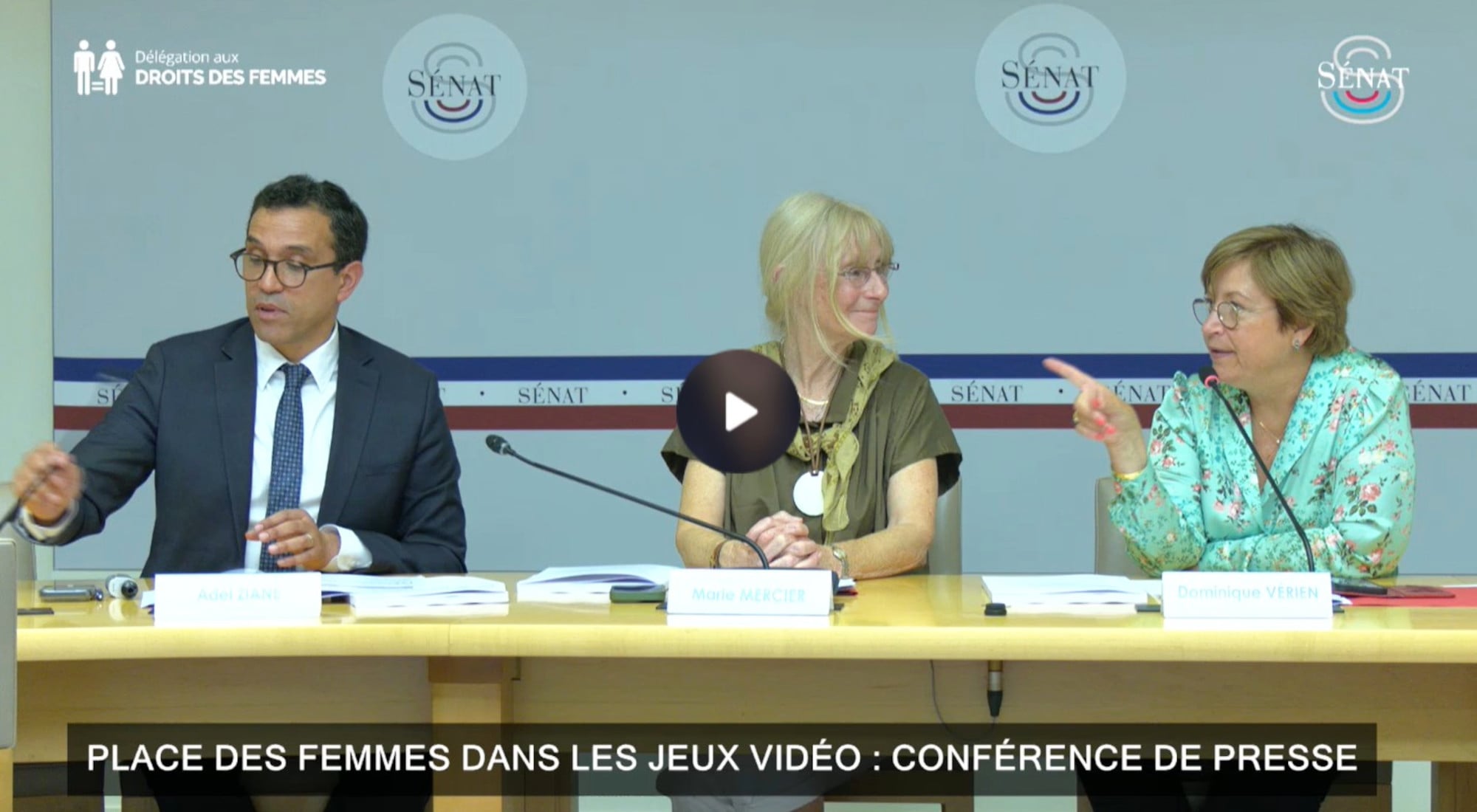
Events in the summer of 2026 brought this issue to the forefront of the political agenda. On 8 July, the Senate’s Women’s Rights Delegation presented its report ‘Jeux vidéo : de la Game Boy aux filles dans le game, l'égalité en cours de chargement’ (3), the result of an eight-month investigation. Hager Jemel-Fornetty, Director of the D&I Chair and Associate Professor at EDHEC, had been invited in late 2025 (5) to present the first scientific test capable of measuring gender parity in video games. The rapporteurs put forward eighteen recommendations to bring balance to an industry where women remain marginalised in studios, management roles and professional competitions.
With more than 3.75 billion gamers worldwide, the cultural and societal issue of representation is a key consideration for the video game industry, which is now being called to account for the role it accords to women. By scrutinising 160 titles released between 1988 and 2025, representing 1.4 billion copies sold, EDHEC has highlighted the scale of the phenomenon for the first time: fewer than 2 per cent of titles achieve gender parity.
An in-depth look at a research study and a tool that are already being cited as benchmarks, and whose impact on both the industry and players is undoubtedly only just beginning.
- Discover EDHEC’s “Gender Parity Test” website : https://www.edhec.edu/html/Gender-Parity-Test/Index_en.html
- Browse the pages of the Diversity & Inclusion Chair : https://www.edhec.edu/en/research-and-faculty/centres-and-chairs/diversity-and-inclusion-chair
- Find out more about the professors leading this research : Guergana Guintcheva and Hager Jemel-Fornetty
A scientific test, the ‘Bechdel test for video games’, to measure the invisible
It all starts with an observation: video games, as a form of mass cultural production, shape representations which, in turn, influence the behaviour and imaginations of players from a very young age. Yet these representations remain marked by well-documented gender stereotypes (6). “For example, female characters are fewer in number, more sexualised and more often confined to roles deemed ‘non-essential’ or ‘passive’,” explains Guergana Guintcheva, EDHEC Professor and co-author on the topic of gender and video games for the chair. “Through these representations, the storytelling of popular culture thus helps to reproduce and legitimise a hierarchy between the genders.”
To move beyond subjective perceptions and analyse this phenomenon objectively, EDHEC’s D&I Chair has developed a novel tool: a gender parity test directly inspired by the famous Bechdel test, which has been used since the 1980s to assess the representation of women in cinema. An initial version, presented by Hager Jemel-Fornetty in 2023 at the Assises de la Parité (7), had already analysed 51 scripts from best-selling games, none of which met all the selected criteria: “Even though I was aware of the scale and depth of current gender inequalities, I was surprised by this result. I thought the figures would be less alarming.”
The methodology has since been considerably expanded. In its most recent version, which is 100 per cent available online, the study covers 160 games released between 1988 and 2025, totalling 1.4 billion copies sold and representing around 14,700 characters and over 6.5 million spoken words analysed.

Each title is analysed in the light of four questions:
- Does the game’s script include an equal number of female and male characters?
- Does the game’s script include an equal number of named female and male characters?
- Do female and male characters speak an equal number of words?
- Does the game’s script include an equal number of playable female and male characters?
At the other end of the scale, some of the biggest commercial successes in the history of video games have particularly low scores. According to the detailed results published by the chair, Grand Theft Auto V (230 million copies sold) fails to meet any of the four criteria, with female representation rates (4) ranging from 0 per cent to 28 per cent; Red Dead Redemption II (87 million copies) has rates between 0 per cent and 16 per cent, whilst The Elder Scrolls V: Skyrim (65 million copies) meets only one criterion, with rates ranging from 28 per cent to 50 per cent.
According to Florine Gallois, a researcher specialising in statistics and sociology at the chair, “these stark gender-based disparities are not a matter of narrative chance: they reflect systemic biases, fuelled by a narrative culture that is more inclined to associate male characters with action and power. ” Moreover, “a previous study by the Chair estimated that over 55 per cent of characters in these roles were male, compared with around 25 per cent for female characters”.

Why these discrepancies persist: diversity within teams and production approaches
How can we explain why studios with considerable resources continue to produce such unbalanced narratives? Part of the answer lies in the very composition of the creative teams. According to Guergana Guintcheva, “the under-representation of women and minorities in games largely mirrors their under-representation behind the scenes. ” In other words, in her view, “a homogeneous team tends to design content that resembles itself, or to create female characters that are unrepresentative, or even sexualised, without this necessarily being deliberate”.
In the context of group dynamics, researchers frequently cite a particular threshold: once a minority group – be it women, LGBT people or people from different social backgrounds – accounts for 30 per cent of a team, its members feel sufficiently supported to express a differing viewpoint and put forward their case. Below this threshold, speaking out becomes risky: a single woman in a team of ten people will, statistically speaking, find it harder to point out what bothers her about a script or a character’s conception. As Florine Gallois puts it: “This dynamic contributes to a vicious circle, where a lack of diversity at the outset perpetuates a lack of diversity in the content produced, which in turn can hinder the entry of new talent into the industry”.
This assessment is supported by recent data on employment in the sector. According to Women in Games France (8), whilst women are playing games more and more, their representation in studios, management roles and professional competitions is stagnating or even declining: the proportion of women in studio workforces has fallen by four percentage points in three years, and now stands at 20 per cent.
!["[...] le manque de diversité en amont perpétue le manque de diversité dans les contenus produits, qui à son tour peut freiner l'arrivée de nouveaux profils dans l'industrie"](/sites/default/files/2026-08/2026-08-espace-travail-manque-diversite.jpg)
From diagnosis to action: a tool developed by the Chair and highlighted by the Senate to transform the industry
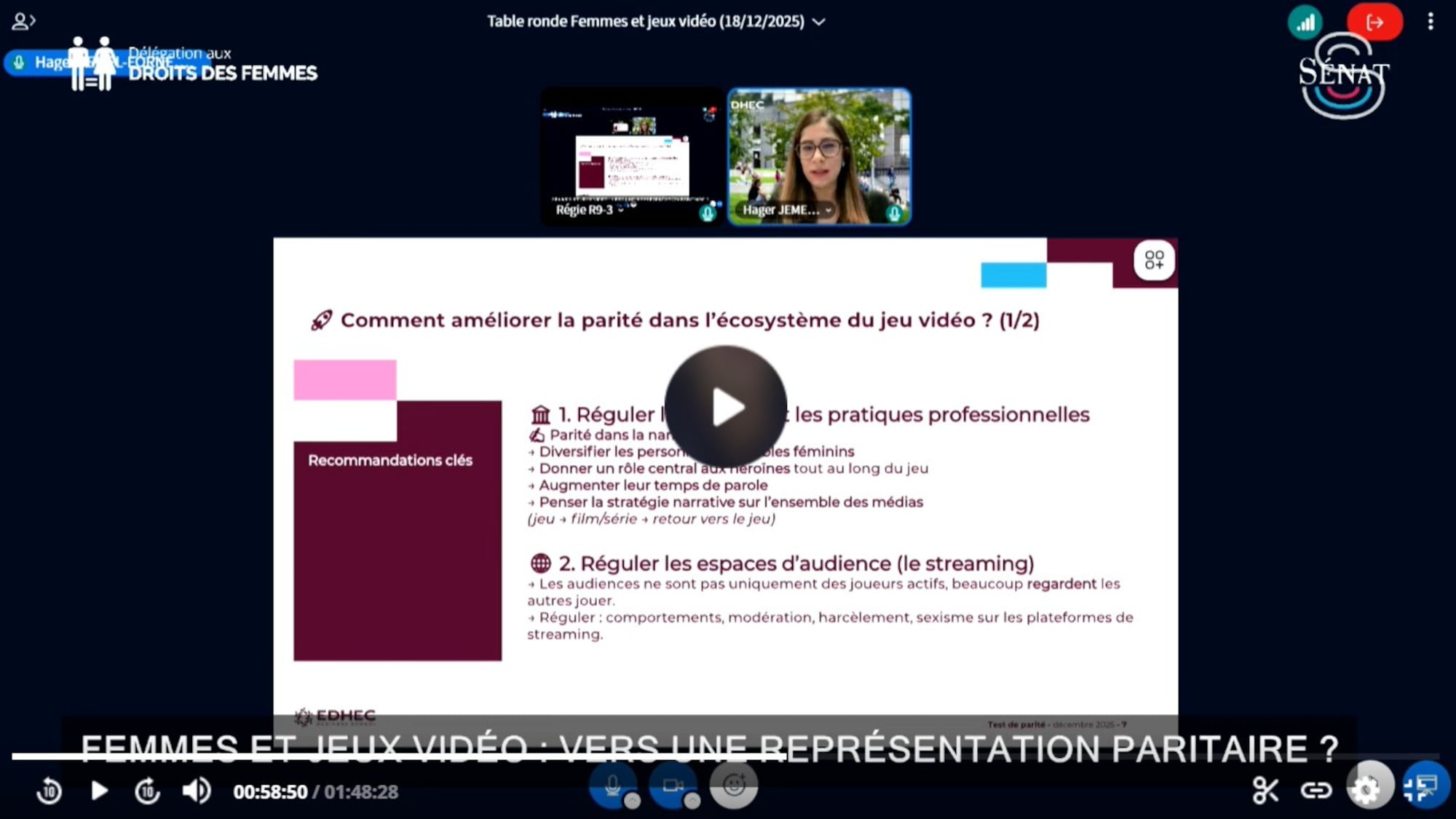
The work carried out by EDHEC and other institutions has not been confined to the academic world. In late 2025 and throughout 2026, the Senate’s Delegation for Women’s Rights addressed the issue of women’s place in the video game industry, as a follow-up to its work on women and girls in science. Hager Jemel-Fornetty was invited to give a talk on this matter on 18 December 2025, alongside other female researchers, to present the results of the gender parity test.
Following dozens of hours of hearings over several months of investigation, the delegation published its fact-finding report on 7 July 2026, entitled “Jeux vidéo : de la Game Boy aux filles dans le game, l'égalité en cours de chargement ” (3). Led by Senators Marie Mercier, Dominique Vérien and Adel Ziane, the report sets out 18 recommendations aimed at increasing the number of women in the sector at all levels, completing what its authors call the “narrative revolution in representations”, and making gaming communities safer and more inclusive spaces. Among the proposals put forward in the report is the idea of making a portion of public funding for the sector conditional on measurable progress in gender equality.
Three priorities underpin the rapporteurs’ recommendations:
- Supporting studios in designing more diverse representations, through training and best-practice guides, under the auspices of a collaborative body bringing together studios, organisations and researchers, “similar to the one developed by EDHEC’s Diversity & Inclusion Chair”.
- To better inform players and their families, in particular by updating existing rating systems, such as the PEGI rating system. To ensure these are also incorporated into mobile games.
- To utilise video games as a tool for media literacy, with a view to fostering critical thinking regarding these representations.
The rapporteur, Adel Ziane, sums up the issue as follows: “Women have already earned their place amongst the players. It is now up to the entire ecosystem to ensure that its narratives, communities and competitions finally reflect this reality”.
This is precisely the ambition set out by the Diversity & Inclusion Chair, which is making its test available to the ecosystem, free of charge and with no restrictions (2). This online platform also allows volunteer players to submit new scripts for testing themselves, in order to continuously expand the database of analysed games. The chair’s director is optimistic that this will build momentum, and hopes that “this work will, of course, foster collaborations with other research teams, both in France and internationally; that it will be made as widely known as possible to the general public; and that it may also become a benchmark shared by an entire industry that is still far from having completed its quest for equality.”
References
(1) The EDHEC Chair in Diversity & Inclusion was established in 2016. Since then, it has been developing a wide range of initiatives and actions to inspire, raise awareness and support individuals and organisations in fostering inclusive, non-discriminatory behaviour and environments - https://www.edhec.edu/en/research-and-faculty/centres-and-chairs/diversity-and-inclusion-chair
(2) The Gender Parity Test is a measurement tool, developed by EDHEC’s Diversity & Inclusion Chair, designed to assess parity (i.e. ‘equality in the number of representatives’) between female and male characters in the dialogue of story-driven video games (primarily role-playing games, action-adventure and adventure games) - https://www.edhec.edu/html/Gender-Parity-Test/Index_en.html
(3) Information Report No. 854 (2025–2026) – Jeux vidéo : de la Game Boy aux filles dans le game, l'égalité en cours de chargement. Delegation for Women’s Rights. Rapporteurs: Marie Mercier, Dominique Vérien, Adel Ziane - https://www.senat.fr/notice-rapport/2025/r25-854-1-notice.html
(4) Inspired by the Bechdel test for films, the Gender Parity Test is based on four questions. To pass this test, a video game must receive a positive response to each of the four questions. A response is considered positive when both calculated percentages fall between 40 per cent and 60 per cent. Example: if, for the first question (“Are there as many female characters as male characters in the game?”), the game under review scores 42 per cent and 58 per cent, this criterion will be “passed” - https://www.edhec.edu/html/Gender-Parity-Test/Index_en.html
(5) Women and video games: towards equal representation? – Women’s Rights Delegation, Thursday 18 December 2025. Hearing with Hager Jemel Fornetty (EDHEC) - https://videos.senat.fr/video.5638163_69439897e68a9.femmes-et-jeux-video--vers-une-representation-paritaire-
(6) Napoleon vs Marie-Antoinette: gender stereotypes in video game narratives. The Conversation France / EDHEC Vox. November 2022 - https://www.edhec.edu/en/research-and-faculty/edhec-vox/gender-stereotypes-in-video-game-narratives
(7) EDHEC, partner of the 2023 Gender Equality Conference. June 2023 - https://www.edhec.edu/fr/news/edhec-partenaire-des-assises-de-la-parite-2023
(8) Women in Games France, 2026 Infographic, The role of women in the video game ecosystem – https://womeningamesfrance.org/infographie-2026-la-place-des-femmes-dans-lecosysteme-du-jeu-video/
Pictures
Header - by Sunriseforever via Pixabay.
Screenshot from the press conference in July 2026, Senate.
An overview of EDHEC’s “Gender Parity Test” website.
Video game covers - by Aaron Douglas via Unsplash
Daytime office hours - by Yolk CoWorking - Krakow via Unsplash
Screenshot of H. Jemel Fornetty’s hearing in December 2025, Senate


